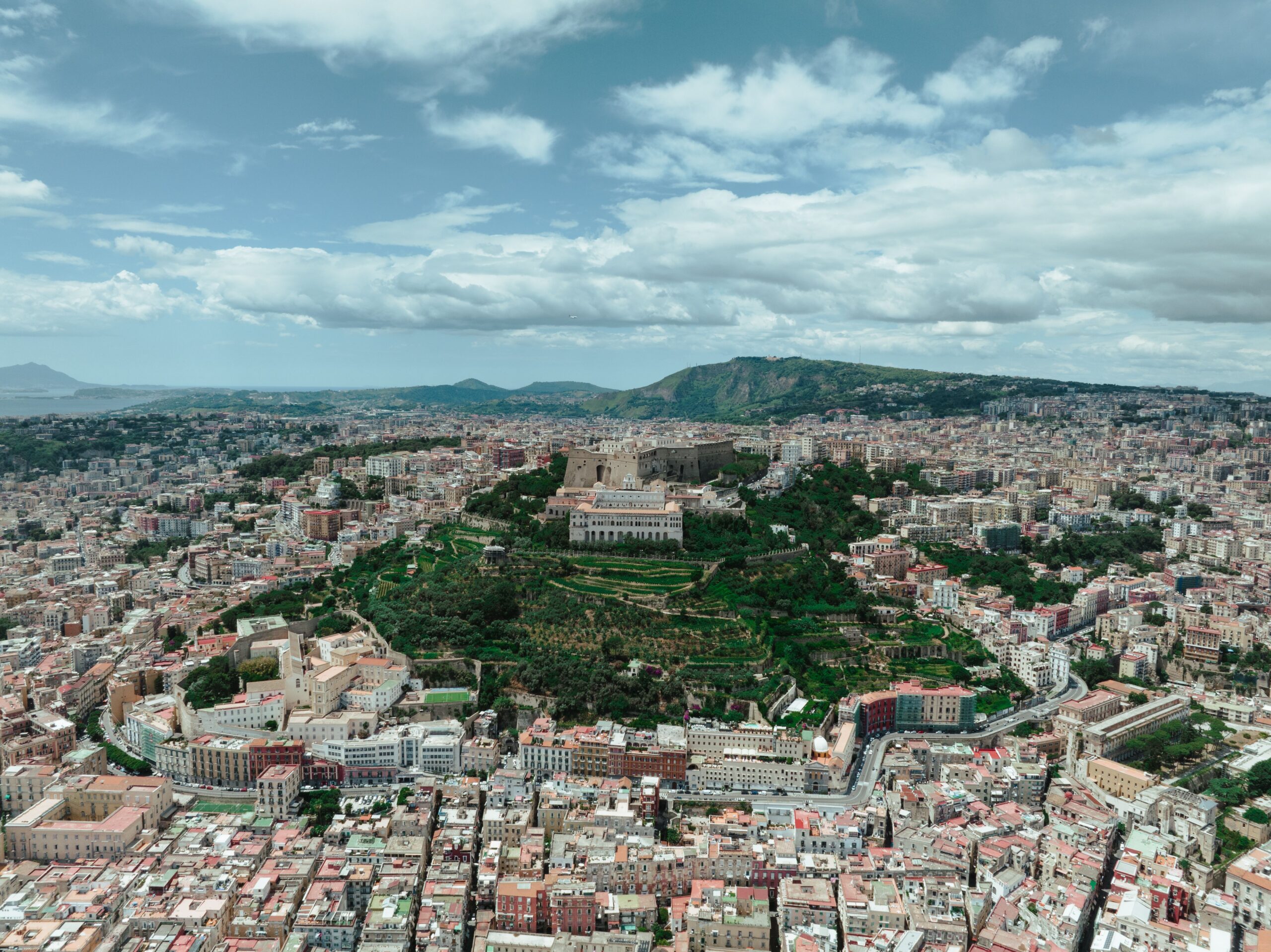
Naples does not try to charm you. It does not arrange itself for photographs or soften its edges for tourism. What it offers instead is something rarer: the unedited version of a city that has been continuously inhabited for 2,800 years, that has been ruled by Greeks, Romans, Normans, Aragonese, Spanish viceroys, and Bourbon kings, and that has absorbed every one of them without quite becoming any of them. A solo traveler willing to walk into that complexity — to follow the street noise down into the Spanish Quarter, to eat standing at a counter, to take the ancient underground seriously — will find a city that gives back in direct proportion to the attention you bring.
The History of Naples: How It Became What It Is
Founded at the Crossroads
Naples was already a city when Rome was still a village. Greek colonists from Cumae established Parthenope on the bay around 700 BCE, then founded a “new city” — Neapolis — nearby in 470 BCE that would outlast every empire built around it. The Greeks chose this site for the same reasons every subsequent ruler coveted it: a deep natural harbor, a volcanic plain of extraordinary fertility, and a position that commanded the Tyrrhenian Sea. The bay you look out at from the seafront promenade is the same bay that Greek sailors navigated by the profile of Vesuvius. The mountain was already there. It was already a threat. The city built itself around that knowledge and never entirely lost it.
The Kingdom That Shaped Europe
From 1282 to 1816, Naples was the capital of one of the most powerful kingdoms in Europe — the Kingdom of Naples, later the Kingdom of the Two Sicilies — and for much of that period the largest city in the Christian world after Paris and Constantinople. The Spanish viceroys who ran it from 1503 to 1707 built the grid of streets and the baroque churches that still define the centro storico. They also created the conditions — overcrowding, inequality, an economy built on spectacle and patronage — that produced Neapolitan popular culture: the music, the street food, the theatrical emotional register that northern Italians still raise an eyebrow at. What looks like chaos to a visitor in 2026 is a social system with deep roots.
What the 20th Century Did Here
The Allied bombing of 1943 and the German occupation that followed left Naples materially destroyed and morally exhausted. What the city did with that exhaustion is the key to understanding it now. Rather than rebuilding toward a clean postwar modernity — the path Milan and Turin took — Naples rebuilt on top of itself, layering new structures onto old ones, filling in bomb damage with whatever was at hand, producing the dense, vertical, improvised urban fabric that defines the historic center. The camorra filled the governance vacuum and never entirely left. So did the artists, the musicians, the philosophers, and the cooks. The result is a city that contains everything simultaneously: third-century Roman markets beneath pizza restaurants, Norman churches next to Spanish palaces, Caravaggio paintings in dim baroque chapels that tourists walk past without going in.
What Makes Naples Distinct: Character, Culture & the Solo Experience
Naples operates at a different frequency from the rest of Italy, and certainly from the rest of Europe. The pace is fast, the noise level is constant, and personal space in the centro storico is a theoretical concept. But within that density, there is a hospitality that has nothing performative about it — the kind that comes from a city where eating alone at a bar counter is completely normal, where asking a stranger for directions produces a five-minute conversation about your plans, where the person next to you in the pizza queue will have an opinion about which variety you should order.
The underground city is the physical expression of Naples’ character: beneath the modern streets run 2,500-year-old Greek aqueducts, Roman cisterns, WWII air raid shelters, and catacombs still full of early Christian frescoes. The city has simply kept building on top of itself because the below was too useful to abandon. That layering — practical, unsentimental, accretive — is how Naples approaches most things.
For the solo traveler, the scale of the centro storico is an asset. The decumani (the ancient Roman streets) are narrow enough to walk end to end in a morning and dense enough to absorb a week. The food culture — espresso at a standing bar, pizza eaten folded in quarters on the street, fried anything from a friggitoria — is designed for one person moving through a city, not a group arranged around a table.
Places That Tell Naples’ Story
The Spaccanapoli. The arrow-straight street that bisects the old city follows the line of the Greek decumanus inferior laid out in the fifth century BCE — the same alignment the Romans kept, that the medieval city kept, that Naples keeps today. Walking it end to end is a lesson in 2,500 years of urban continuity compressed into a single kilometer.
The Museo Archeologico Nazionale. The finest collection of Roman antiquities in the world, most of it excavated from Pompeii and Herculaneum. The frescoes, the mosaics, the secret cabinet of erotic art that required a special ticket until 2000 — this is where Rome’s daily life is stored, better preserved here than anywhere in Rome itself.
The Catacombs of San Gennaro. Fourth-century Christian burial tunnels beneath the hill of Capodimonte, with frescoes intact and a guided tour that makes clear how early Christianity spread through the Roman world: not from the top down, but through networks of working people who built their devotion into the rock.
Cappella Sansevero. An 18th-century funerary chapel containing Giuseppe Sanmartino’s Veiled Christ — a marble sculpture of such technical impossibility that visitors have been circling it trying to understand it for 260 years. The chapel also contains anatomical machines in the basement that no one has adequately explained. Small, strange, and unforgettable.
Piazza del Plebiscito. The enormous Bourbon-era piazza fronting the Royal Palace tells you everything about what Naples’ rulers were trying to prove: a neoclassical colonnade, a church modeled on the Pantheon, and a palace that was the largest in Europe when it was built. The ambition is on the surface. The city that ignored all of it and kept living its own way is in the streets behind.
Why Naples Rewards the Solo Traveler
Naples is a city that gives more to the person who arrives alone and curious than to any group. The conversations happen one-on-one at bar counters and pizza windows. The underground tours work best when you are paying attention to the guide rather than managing companions. The ability to walk into a small trattoria at noon and take the one available stool is not a consolation — it is the correct way to eat in this city. Naples is also one of the few major European cities where arriving without a full itinerary is genuinely productive: the centro storico is compact enough to navigate by instinct, and getting lost in the Spanish Quarter or the Quartieri is not a problem — it is the point.
48 HOURS IN NAPLES — THE GUIDE
The guide gives you the hour-by-hour sequence through the centro storico, Spaccanapoli, the waterfront, and Capodimonte — with exact pizzerias, espresso bars, the underground tour logistics, and the ferry connections to Procida and Ischia if you want a half-day on the water. It is the operational layer this article does not provide.
Get the 48 Hours in Naples guide → $7.99
Browse all 48-Hour Guides at GoingSolo.Life/guides/
Ready to Go?
Naples rewards the solo traveler who arrives without preconceptions and stays curious. The city does not perform for visitors — it simply goes about its business, and invites you to fall into step. Browse all the 48-Hour Guides at GoingSolo.Life/guides/ — 20 cities and counting, each one built for the traveler who wants to understand a place before they arrive.
48-Hour City Guides
Ready to Go? Grab Your Guide.
Hour-by-hour itineraries built for independent travelers.
London, Paris, Vienna, Prague, Amsterdam and more — $7.99 each.
