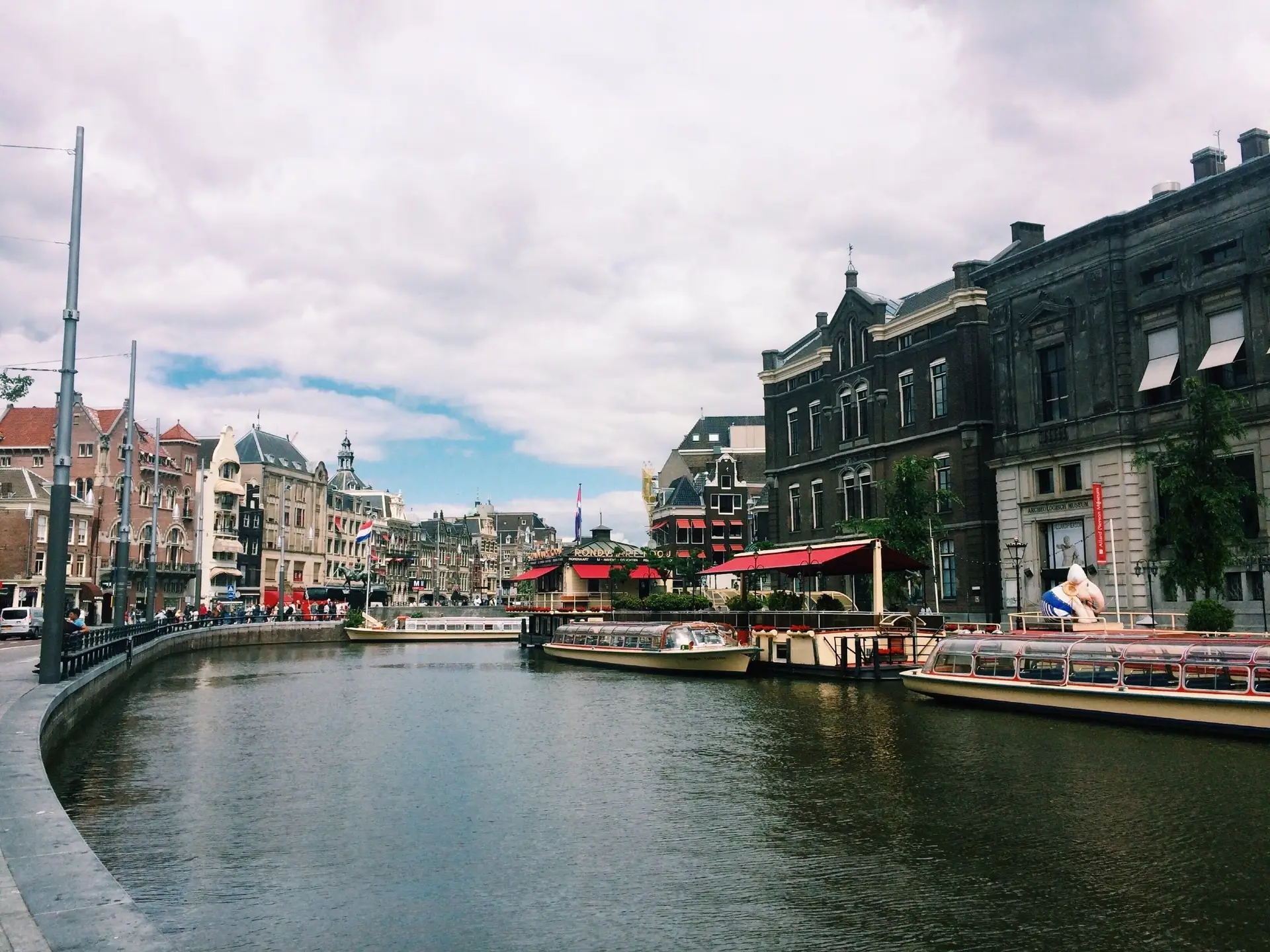
Amsterdam makes more sense when you stop treating it like a postcard and start reading it as a city built by water, trade, restraint, and private lives lived behind tall windows. Its beauty is not accidental; the canals, narrow houses, bridges, warehouses, museums, and brown cafés all come from a place that learned how to turn limited land into extraordinary urban intimacy. For a solo traveler, that intimacy matters — Amsterdam gives you space to wander without feeling lost, and enough detail to make walking alone feel like paying attention.
The History of Amsterdam: How It Became What It Is
Amsterdam’s story begins with water control before it becomes a story of wealth. The city’s earliest official written mention dates to 1275, when Count Floris V granted a toll privilege to people living near “Amestelledamme,” a small settlement around a dam on the Amstel River. That document matters because it shows Amsterdam’s first great advantage: movement. Goods, boats, traders, fishermen, and river traffic could pass through more freely, and the city’s future began with access rather than grandeur.
The Dam That Became a Trading City
Amsterdam did not begin with palaces. It began with peat, water, fish, beer, timber, grain, and the practical genius of people who understood rivers. By the 14th and 15th centuries, the town’s connection to Baltic trade helped turn it into a serious commercial center. The city’s flatness, compactness, and canal logic still carry that origin story. Amsterdam feels human-scaled because it grew around movement: boats, bridges, quays, warehouses, markets, and houses squeezed into narrow plots where every meter mattered. Knowing that changes how the city looks. The prettiness is functional. The charm came later.
The Golden Age and the City Built in Rings
The great transformation came in the late 16th and 17th centuries, when Amsterdam expanded into one of Europe’s most important port cities. UNESCO describes the canal ring as a planned urban project built at the end of the 16th and beginning of the 17th centuries, with new canals laid west and south of the old medieval town. The Herengracht, Keizersgracht, and Prinsengracht were not decorative gestures. They were infrastructure for a merchant republic: water, status, storage, movement, and money arranged into a controlled urban pattern. Amsterdam’s Golden Age still survives in that geometry.
Memory, Reinvention, and the Modern City
The 20th century complicated Amsterdam’s image. The city suffered under Nazi occupation during World War II, and the Anne Frank House remains one of the clearest reminders of that rupture; the organization was established in 1957 to preserve the hiding place and open it to the public. After the war, Amsterdam kept reinventing itself: counterculture, migration, cycling infrastructure, museum renewal, creative districts, and a constant tension between local life and global attention. The result is a city both fragile and resilient — a place where beauty and memory sit close together.
What Makes Amsterdam Distinct: Character, Culture & the Solo Experience
Amsterdam’s character comes from compression. The city is small enough to feel knowable, yet layered enough to keep resisting simple readings. A canal can hold 17th-century merchant wealth, wartime memory, student life, design culture, and a quiet local bar within the same five-minute walk. That closeness gives the city its emotional charge.
The social culture is direct, casual, and often more reserved than visitors expect. Amsterdam does not perform friendliness in the loudest way. It gives independence. People eat alone, read alone, cycle alone, sit at windows alone, and move through public life with little fuss. That makes it unusually comfortable for solo travelers. You rarely feel out of place simply because you are on your own.
Its brown cafés help explain this better than any museum label. These bruine kroegen are traditional Dutch pubs known for dark wood, warm interiors, and a lived-in atmosphere, often described through the brown tones left by old smoke-stained walls. They function less like nightlife venues and more like neighborhood living rooms. Amsterdam’s best quality may be this: it lets solitude become social without forcing conversation.
Places That Tell Amsterdam’s Story
The Canal Ring: The 17th-century canal ring is Amsterdam’s clearest physical statement: a planned cityscape created for trade, defense, status, and expansion. It tells you that Amsterdam’s beauty came from order, water management, and merchant ambition rather than royal display.
Dam Square: Dam Square marks the city’s origin point around the dam on the Amstel. What feels today like a crowded central square began as the practical heart of a settlement that learned to turn water control into power.
The Rijksmuseum: The Rijksmuseum building, designed by Pierre Cuypers and officially opened in 1885, combines Gothic and Renaissance influences in a building made to house national memory. It tells the story of a country that turned painting, trade, domestic life, naval power, and civic confidence into cultural identity.
The Van Gogh Museum: The Van Gogh Museum holds more than 200 paintings and almost 500 drawings by Vincent van Gogh. It reveals a different Dutch legacy from the Golden Age: not merchant certainty, but emotional intensity, experiment, and the lonely force of artistic vision.
The Anne Frank House: The Anne Frank House preserves the hiding place connected to one of the most important personal documents of the Holocaust. Its presence inside the canal belt forces Amsterdam’s beauty to carry moral weight, reminding visitors that history here includes absence, persecution, and survival.
The Jordaan: The Jordaan began as a working-class district outside the grandest merchant canals and later became one of Amsterdam’s most loved neighborhoods. It tells a quieter story of the city: artisans, small houses, local cafés, narrow streets, and the kind of urban life that gives Amsterdam its human scale.
Why Amsterdam Rewards the Solo Traveler
Amsterdam rewards solo travelers because the city is built for individual movement. You do not need a group to make sense of it. The canals create natural orientation. The neighborhoods shift gradually rather than abruptly. The museums give structure without demanding speed. The brown cafés and small streets make lingering feel normal.
There is also a rare emotional fit between Amsterdam and solo travel. The city allows you to be anonymous without becoming invisible. You can walk beside the water, sit at a window, study a painting, cross a bridge, or pause in a quiet square, and none of it feels like wasted time. Amsterdam is not only a city to see. It is a city to notice.
48 HOURS IN AMSTERDAM — THE GUIDE
This article gives you the context. The guide turns that context into a real trip, with an hour-by-hour sequence, exact museum timing, brown café strategy, restaurant picks with prices, transport tips, backup plans, and insider moves designed specifically for solo travelers.
Ready to Go?
Amsterdam is best approached with curiosity rather than a checklist. Let the city’s canals, museums, cafés, and quiet corners teach you how to move through it.
Browse all the 48-Hour Guides today.
48-Hour City Guides
Ready to Go? Grab Your Guide.
Hour-by-hour itineraries built for independent travelers.
London, Paris, Vienna, Prague, Amsterdam and more — $7.99 each.
