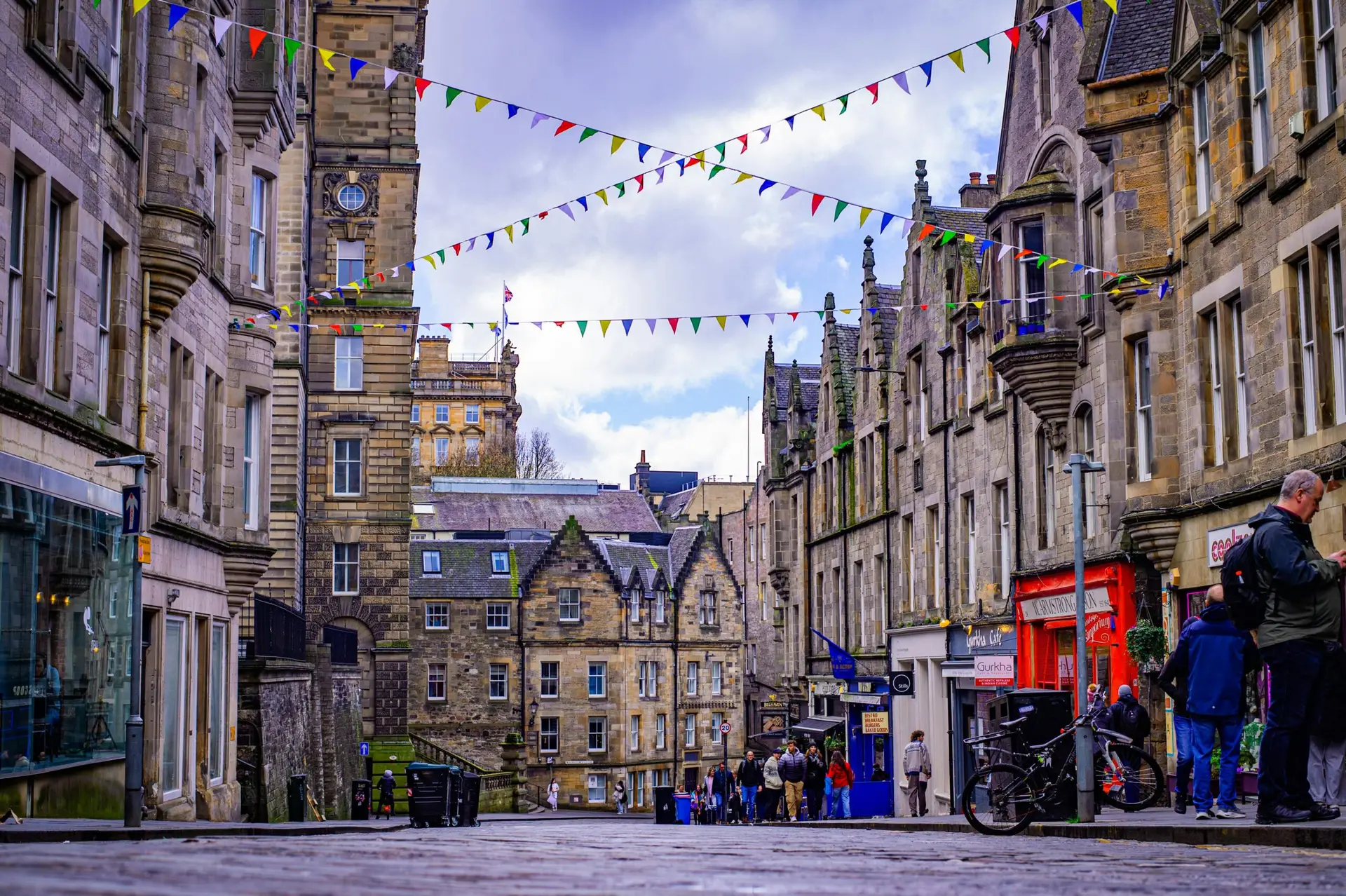
Edinburgh makes more sense when walked alone. The city rises and folds in ways that constantly interrupt your direction with a better view, a darker close, a staircase disappearing beneath stone arches, or a pub that suddenly feels worth abandoning your plans for. A group tends to move through Edinburgh looking for landmarks. A solo traveler notices the transitions between them — the way the Old Town narrows into shadow, the sudden order of the Georgian streets below, the wind arriving off the Firth of Forth just as the castle comes back into view.
The History of Edinburgh: How It Became What It Is
Edinburgh’s geography explains almost everything about it. The city grew around volcanic rock formations that created natural defensive positions, most importantly Castle Rock, where Edinburgh Castle still dominates the skyline today. The medieval Old Town developed along the ridge extending east from the castle, compressed into steep, densely packed streets because defensive walls restricted outward growth for centuries. That vertical density is still visible now. The closes and wynds that confuse visitors today were once practical solutions to overcrowding inside fortified walls. Edinburgh feels dramatic because its geography forced it to become dramatic.
The Medieval Capital and the Castle Above It
Edinburgh emerged as Scotland’s political center during the Middle Ages, but the city’s defining symbolism came through conflict. Edinburgh Castle changed hands repeatedly during the Wars of Scottish Independence in the 13th and 14th centuries, becoming one of the most contested fortresses in Britain. The Royal Mile developed beneath it as both a commercial spine and a political statement: a processional route connecting military power at the castle with royal authority at Holyrood Palace. Once you understand that relationship, the Old Town stops feeling picturesque and starts feeling strategic. Even today, the city’s skyline is organized around authority, elevation, and defense.
The Enlightenment and the New Town
By the 18th century, Edinburgh’s medieval center had become overcrowded and unhealthy, prompting one of the most ambitious urban redesigns in Europe. In 1767, a young architect named James Craig won the competition to design Edinburgh’s New Town: an ordered Georgian expansion built on Enlightenment ideals of symmetry, rationality, and civic improvement. Wide streets, elegant squares, and restrained neoclassical architecture replaced the compressed disorder of the Old Town. The result remains one of the finest examples of planned urban design anywhere in Europe. Edinburgh became known as the “Athens of the North” not simply because of aesthetics, but because the city became a major intellectual center producing figures such as David Hume and Adam Smith. Walking between the Old and New Towns still feels like crossing between two competing ideas of civilization.
The Modern City Beneath the Postcard
Modern Edinburgh carries its history unusually lightly. Unlike many European capitals, much of its architectural core survived the destruction that reshaped cities during the 20th century, allowing the city to retain an unusual sense of continuity. But Edinburgh is not frozen in heritage. Leith, once an independent port absorbed into the city in 1920, has transformed into one of Britain’s strongest food and cultural neighborhoods. The Edinburgh Festival Fringe, launched in 1947 when independent performers arrived uninvited alongside the official arts festival, turned the city into the world’s largest arts festival every August. Modern Edinburgh now balances intellectual seriousness, literary identity, political symbolism, and artistic experimentation simultaneously. The city’s atmosphere comes from that tension: ancient stone meeting contemporary cultural energy without either one fully overpowering the other.
What Makes Edinburgh Distinct: Character, Culture & the Solo Experience
Edinburgh feels more introspective than many European capitals. The city rewards observation rather than urgency. Its pleasures tend to unfold gradually: a hidden close off the Royal Mile, a pub conversation that lasts longer than expected, a sudden shift in weather changing the entire mood of the skyline within minutes. Solo travelers tend to adapt naturally to that rhythm because Edinburgh rarely pressures you into speed.
The city also handles solitude exceptionally well. Scottish pub culture — especially in Edinburgh — remains unusually welcoming to people sitting alone at the bar with a pint or whisky and no visible agenda beyond being there. That matters more than guidebooks often acknowledge. In some cities, being alone in public can feel conspicuous. In Edinburgh, it feels normal. The same applies to cafés, gallery visits, long walks through Dean Village or along the Water of Leith, or spending an hour on Calton Hill without speaking to anyone.
Edinburgh’s physical structure also favors independent exploration. The city is compact enough to cross largely on foot, but visually layered enough that perspectives constantly change depending on elevation. The Old Town feels medieval and vertical. The New Town feels rational and restrained. Leith feels maritime and contemporary. Stockbridge feels residential and quietly affluent. The city never fully flattens into a single atmosphere. That makes wandering unusually rewarding because moving only a few streets can completely alter the emotional texture of the city.
Places That Tell Edinburgh’s Story
Together, these historic sites in Edinburgh reveal a city shaped by royal ambition, intellectual life, religious conflict, and centuries of political tension that still linger in the streets today.
Edinburgh Castle dominates the volcanic rock above the city and has served as both fortress and royal residence for centuries. More than any single landmark, it explains why Edinburgh developed as a city shaped by defense, elevation, and political symbolism.
The Royal Mile connects Edinburgh Castle to Holyrood Palace through the spine of the medieval Old Town. Walking it reveals how tightly compressed the historic city once was and how public life, trade, politics, and survival were forced into the same narrow urban corridor.
Calton Hill offers the clearest view of Edinburgh’s competing identities in one frame: medieval Old Town, Georgian New Town, volcanic landscape, and the Firth of Forth beyond. The unfinished National Monument atop the hill reflects both Scotland’s Enlightenment ambitions and its complicated relationship with national identity.
Holyrood Palace remains the monarch’s official Scottish residence, but its atmosphere is shaped most powerfully by Mary Queen of Scots and the murder of her secretary David Rizzio inside the palace in 1566. The palace reveals Edinburgh not as abstract history, but as a city shaped by deeply personal political conflict.
Leith tells the story of Edinburgh as a maritime and commercial city rather than purely a royal or intellectual one. Its docks, warehouses, and modern restaurant culture reveal how Edinburgh continues reinventing itself without entirely losing its working identity.
The Scottish National Gallery reflects Edinburgh’s role during the Scottish Enlightenment as a city that deliberately positioned itself within broader European intellectual and artistic culture. The collection feels less imperial than London’s museums and more connected to Scotland’s long attempt to define itself culturally within Europe.
Why Edinburgh Rewards the Solo Traveler
Edinburgh rewards solo travelers because the city naturally encourages self-directed pacing. It is built around walking, observation, and gradual discovery rather than constant stimulation. Some of the city’s best moments happen unexpectedly: a staircase opening toward the castle, traditional music drifting from a pub basement, fog moving across the rooftops, or an extra hour spent in a neighborhood you never planned to visit.
The city also offers a rare combination of emotional atmosphere and practical ease. It is large enough to feel culturally substantial, but compact enough to feel manageable alone. Its café culture, pubs, museums, parks, and long walking routes all make solitude feel entirely natural rather than socially awkward.
Most importantly, Edinburgh rewards curiosity. A group traveler often experiences the city as a sequence of attractions. A solo traveler notices how the city changes between them: the transition from medieval stone to Georgian order, the sudden silence inside a close off the Royal Mile, the shift from literary elegance to working port energy once you reach Leith. Edinburgh is a city that becomes more coherent the longer you move through it slowly.
48 HOURS IN EDINBURGH — THE GUIDE
This article gives you the context. The guide turns that context into a real trip, with an hour-by-hour sequence, exact pub and restaurant picks with prices, Edinburgh Castle timing strategy, walking routes through the closes, Leith neighborhood flow, transport guidance, and insider moves designed specifically for solo travelers.
Ready to Go?
Edinburgh is one of the rare cities that reveals itself more completely when you stop trying to conquer it. Give yourself time in the closes, time above the city on Calton Hill or Arthur’s Seat, and enough unscheduled hours for the atmosphere to settle properly around you.
Browse all the 48-Hour Guides today— 16 European cities and counting.
48-Hour City Guides
Ready to Go? Grab Your Guide.
Hour-by-hour itineraries built for independent travelers.
London, Paris, Vienna, Prague, Amsterdam and more — $7.99 each.
