Solo travel doesn’t mean lonely travel. That’s a distinction worth repeating, especially if you’re over 50 and wondering whether heading out on your own to Barcelona, Chicago, or Lisbon means spending every evening at a restaurant table for one, staring at your phone. The truth is, some of the richest human connections happen precisely when you’re traveling solo. You’re open, curious, and free from the social scripts that come with group trips. This guide shows you what community really looks like for mature solo travelers, where to find it in just 48 hours, and how to build it confidently and authentically.
Table of Contents
- Redefining community for solo travelers
- Where to find community: City experiences that connect
- How to authentically connect: Mindset and actionable steps
- Community challenges and how to overcome them
- Why your definition of community may be holding you back
- Connect deeper: Resources to empower your solo journeys
- Frequently asked questions
Key Takeaways
| Point | Details |
|---|---|
| Community is flexible | Solo travelers over 50 can find meaningful connections in brief, shared city experiences. |
| Cities offer social spaces | Urban tours, hostels, and group dining are excellent for meeting like-minded travelers. |
| Mindset shapes experience | Openness and curiosity make authentic connections easier for mature solo travelers. |
| Overcome common barriers | Simple strategies can help address social and generational challenges while traveling alone. |
Redefining community for solo travelers
With the myth of isolation challenged, let’s define what “community” really means for solo travelers like you.
Most people picture community as a tight-knit group of longtime friends or a neighborhood you’ve known for decades. However, that static framing can actually work against you when you travel solo. On the road, community is far more fluid, immediate, and surprising. For instance, it might be the retired teacher from Portland you share a walking tour with in Seville. Other times, it’s the communal dinner table at a small trattoria in Rome where conversation flows as naturally as the wine. Ultimately, it is the profound feeling of belonging, even briefly, to a place and its people.
For solo travelers over 50, resetting through solo travel often means stepping away from familiar roles, whether that’s parent, colleague, or caregiver, and rediscovering who you are when no one has expectations of you. That space creates a genuine openness to new people. Research confirms that solo travelers engage in community experiences within hospitality settings far more readily than those traveling in groups, precisely because they aren’t already insulated by their own social bubble.
“Community isn’t about permanence. It’s about presence. One honest conversation with a stranger in a foreign city can stay with you longer than a year of small talk back home.”
The loneliness myth in solo travel is worth confronting head-on. Yes, there are quiet evenings. Yes, there are moments when you wish someone else were there to share the view. But loneliness and solitude are not the same thing, and most mature solo travelers learn to tell the difference quickly.
What real community looks like for mature solo travelers:
- Sharing a meal at a communal table with other travelers or locals
- Joining a small-group city walk focused on a shared interest like food, architecture, or history
- Striking up a conversation at a museum café or a hotel lounge
- Attending a local cultural event, market, or festival
- Connecting with fellow solo travelers through a hostel social hour or hotel-organized activity
- Exchanging recommendations with someone at a bookshop or wine bar
None of these require a formal group tour or a pre-planned social agenda. They just require you to show up and stay open.
Where to find community: City experiences that connect
Now that we’ve defined community, let’s explore where and how to find it during your city adventures.
The good news is that cities are designed for human interaction. The trick is knowing which settings actively encourage it and which ones quietly isolate you. A solo traveler who books a standard hotel room and eats every meal at a corner table will have a very different experience than one who seeks out the right environments intentionally.
Hotels and hostels in the best European cities for solo travel are increasingly designing social spaces, from shared breakfast counters to rooftop lounges, specifically to encourage conversation among guests. Boutique hotels in cities like Porto, Prague, and Amsterdam often host evening events where guests mix naturally. You don’t have to stay in a hostel dorm to benefit from this trend. Many mid-range and upscale hotels now offer communal dining options or social hours.

Best settings for connecting as a solo traveler:
| Setting | Connection potential | Best for |
|---|---|---|
| Small-group walking tours | Very high | Meeting fellow travelers with shared interests |
| Communal dining tables | High | Relaxed, natural conversation over food |
| Hotel or hostel social lounges | High | Low-pressure mingling at your own pace |
| Museum cafés and galleries | Medium | Quiet, interest-based conversations |
| Local markets and food halls | Medium | Brief but warm exchanges with vendors and locals |
| Cooking or cultural classes | Very high | Structured interaction with shared purpose |
Activities that reliably create genuine interaction:
- Food tours where tasting and sharing are built into the format
- Themed walking tours (street art, literary history, neighborhood architecture)
- Wine or craft beer tastings at small producers
- Language exchange meetups in cafés
- Volunteer or community service mornings organized through local groups
- Yoga or fitness classes at neighborhood studios
Finding solo-friendly restaurants is also a skill worth developing. Counter seating, chef’s tables, and communal long tables all create natural opportunities for conversation without forcing it. And if you’re nervous about eating alone, there are solid tips for solo dining that make the whole experience feel easy and even enjoyable.
Pro Tip: Before you arrive in a city, search for walking tours or themed dinners specifically marketed to solo travelers. Many operators in cities like Paris, New York, and Edinburgh now run events designed for people traveling alone, which means everyone in the room is already in the same mindset as you.
How to authentically connect: Mindset and actionable steps
Knowing the “where” is just the beginning. Here’s how you can take real steps to turn these opportunities into lasting connections.
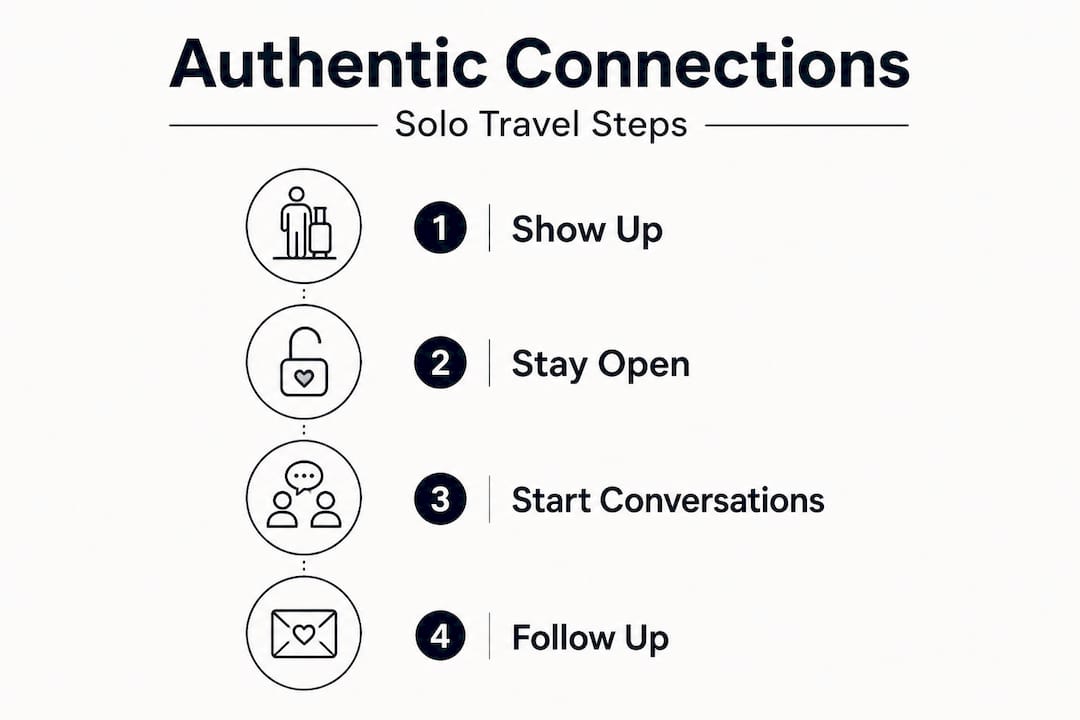
Mindset matters more than you might expect. The travelers who consistently build community during short city stays share a few common traits. They’re curious rather than cautious. They’re patient with awkward silences. And they don’t put pressure on every interaction to become a deep friendship. Sometimes a 20-minute conversation over coffee is the whole point, and that’s enough.
The lessons from your first solo international trip often come down to this: the moments you remember most aren’t the famous landmarks. They’re the unexpected human exchanges. The woman who recommended a tiny bakery that wasn’t in any guidebook. The retired couple who invited you to join their table because you looked like you knew the city well. These things happen when you’re present and approachable.
Steps for engaging with others authentically:
- Smile and make eye contact. This sounds basic, but it’s genuinely powerful. A warm, relaxed expression signals that you’re open to interaction without being intrusive.
- Initiate with a low-stakes comment. “Have you tried the food here before?” or “Do you know which direction the old town is?” are easy, natural openers that don’t feel forced.
- Join communal or group events. Sign up for the hotel’s walking tour, the hostel’s city orientation, or the cooking class at the market. Structured activities remove the pressure of having to generate conversation from scratch.
- Follow up when it feels right. If you meet someone you click with, suggest continuing the conversation over coffee or dinner. Most solo travelers are genuinely happy to have company for part of an evening.
- Set your own boundaries. You don’t have to say yes to every invitation. Part of traveling solo is the freedom to choose your level of engagement on any given day. Honor that.
- Be curious about their story. People love to talk about what brought them to a place. Ask where they’re from, what they’ve discovered, what surprised them. Curiosity is the fastest route to genuine connection.
Pro Tip: Carry one conversation starter in your back pocket. Something like “I’m looking for a hidden gem in this neighborhood that most tourists miss. Have you found anything?” works in almost any city and almost any setting. It positions you as an explorer, not a lost tourist, and invites the other person to share something they’re proud of knowing.
As solo travel gets better with experience, you’ll find that your confidence in initiating conversations grows naturally. The first trip is always the hardest. By the third or fourth, you’ll wonder why you ever hesitated.
Community challenges and how to overcome them
While authentic connections are possible, you may still face some real-world hurdles. Let’s tackle these together.
No guide would be complete without acknowledging the friction points. Building community as a solo traveler over 50 comes with specific challenges that are worth naming honestly, because once you name them, they lose most of their power.
Common obstacles and simple strategies:
- Language barriers: Don’t let them stop you. A smile, a phrase learned from a translation app, and genuine enthusiasm go a long way. Most locals appreciate the effort, even if the pronunciation is imperfect.
- Technology anxiety: Many community-building tools, like Meetup, Couchsurfing events, or city-specific Facebook groups, require a smartphone. If apps feel overwhelming, start with just one. The payoff in connection opportunities is worth the learning curve.
- Social anxiety: This is more common than people admit, even among experienced travelers. Start small. One brief conversation per day is a realistic, manageable goal that builds momentum.
- Generational differences: You may find yourself in spaces where most other travelers are younger. Lean into it. Younger travelers often genuinely enjoy the perspective and stories that come with more life experience.
- Fear of rejection: Most “rejections” in travel settings are simply people who are tired, distracted, or introverted. It’s rarely personal. Move on warmly and try again.
| Challenge | Practical solution |
|---|---|
| Language barrier | Use a translation app, learn 5 key phrases, rely on warmth and body language |
| Tech anxiety | Start with one app, ask hotel staff for help setting it up |
| Social anxiety | Set a small daily goal: one conversation, one shared meal |
| Generational gap | Share your travel stories; curiosity bridges age differences quickly |
| Fear of rejection | Reframe it as redirection; the right connection is always one conversation away |
Using a travel advisor is another underused strategy. A good advisor who specializes in solo travel can pre-identify social events, community-friendly accommodations, and local guides who are skilled at helping solo travelers feel included. The impact of community on solo traveler satisfaction is significant, and advisors who understand this can build it directly into your itinerary before you even leave home.
Why your definition of community may be holding you back
Traditionally, we’ve been conditioned to think of community as something you belong to over time. Your neighborhood, your church, or your book club, for instance, are all built on repetition and history. Of course, that’s a beautiful thing. Yet, when you carry that exact definition into solo travel, it quietly sets you up for disappointment. This is because you’re measuring 48-hour connections against a standard that took years to build.
Instead, what if community in travel is something entirely different? What if it’s better understood as a series of genuine moments rather than a sustained relationship? Consider, for example, the conversation with a stranger at the train station who recommends a restaurant that becomes the highlight of your trip. Similarly, think of the brief camaraderie of a walking tour group that disperses after two hours but leaves you feeling less alone in the world. These moments are real, and consequently, they count.
In fact, personal insights from resetting through solo travel consistently point to this truth: the connections that surprise you most are often the ones that matter most. This isn’t because they last, but rather because they were completely unscripted. In those moments, nobody was playing a role; you were just two people in the same place, curious about the same things, for a little while.
Ultimately, broadening your definition of community doesn’t lower the bar. On the contrary, it raises the ceiling. When you stop waiting for the “right” group of people and start engaging with whoever is directly in front of you, the quality of your travel experience transforms. As a result, you stop being a visitor simply moving through a city and start feeling like, for a moment at least, you actually live there.
Connect deeper: Resources to empower your solo journeys
Inspired to try a new approach? Here are resources to help you go further.
At GoingSolo.life, we’ve built everything around the idea that solo travel over 50 should be rich, intentional, and genuinely connected. Whether you’re planning your first solo city break or your fifteenth, the right resources make all the difference.

Our 48-hour city guides for solo travelers are designed to do more than just list attractions. They point you toward the specific neighborhoods, restaurants, and experiences where real community happens naturally. We also maintain a curated collection of best travel apps for solo travelers that make it easier to find social events, navigate new cities, and stay connected without feeling overwhelmed by technology. And if you want a head start before you even book your flights, consider working with a solo travel advisor who understands exactly what mature solo travelers need. You’ve got a whole community waiting to meet you.
Frequently asked questions
How do I meet other solo travelers over 50?
Join communal city tours, group meals, and social events designed for solo travelers. Many hotels and hostels now design social spaces specifically to encourage these authentic connections.
Is it easy to find community during short solo city stays?
Yes, many urban experiences like walking tours and communal dining are structured to help solo travelers build connections quickly, even within a single afternoon.
How can I balance privacy and socializing as a mature solo traveler?
Choose activities where you control your level of interaction. Joining a group meal while staying in a private room, for example, gives you social comfort without feeling awkward or overexposed.
What if I feel awkward starting conversations?
Use shared interests like local food or a nearby attraction as your opener. Resetting your mindset before a trip helps you approach strangers with curiosity rather than anxiety, which makes every conversation easier to start.
Recommended
- Solo Travel After 60: The best is ahead of you – Going Solo Life Travel
- Travel Insurance in 2026: What to know
- Solo travel as a reset — one empty nester’s guide to going first – Going Solo Life Travel
- New York City for the Solo Traveler and Everyone Else – Going Solo Life Travel
Article generated by BabyLoveGrowth
read alone, travel alone —
Ready to Go? Grab Your Guide.
Hour-by-hour itineraries built for independent travelers.
Free 48-hour guides, safety guides, and interactive maps — every city.
