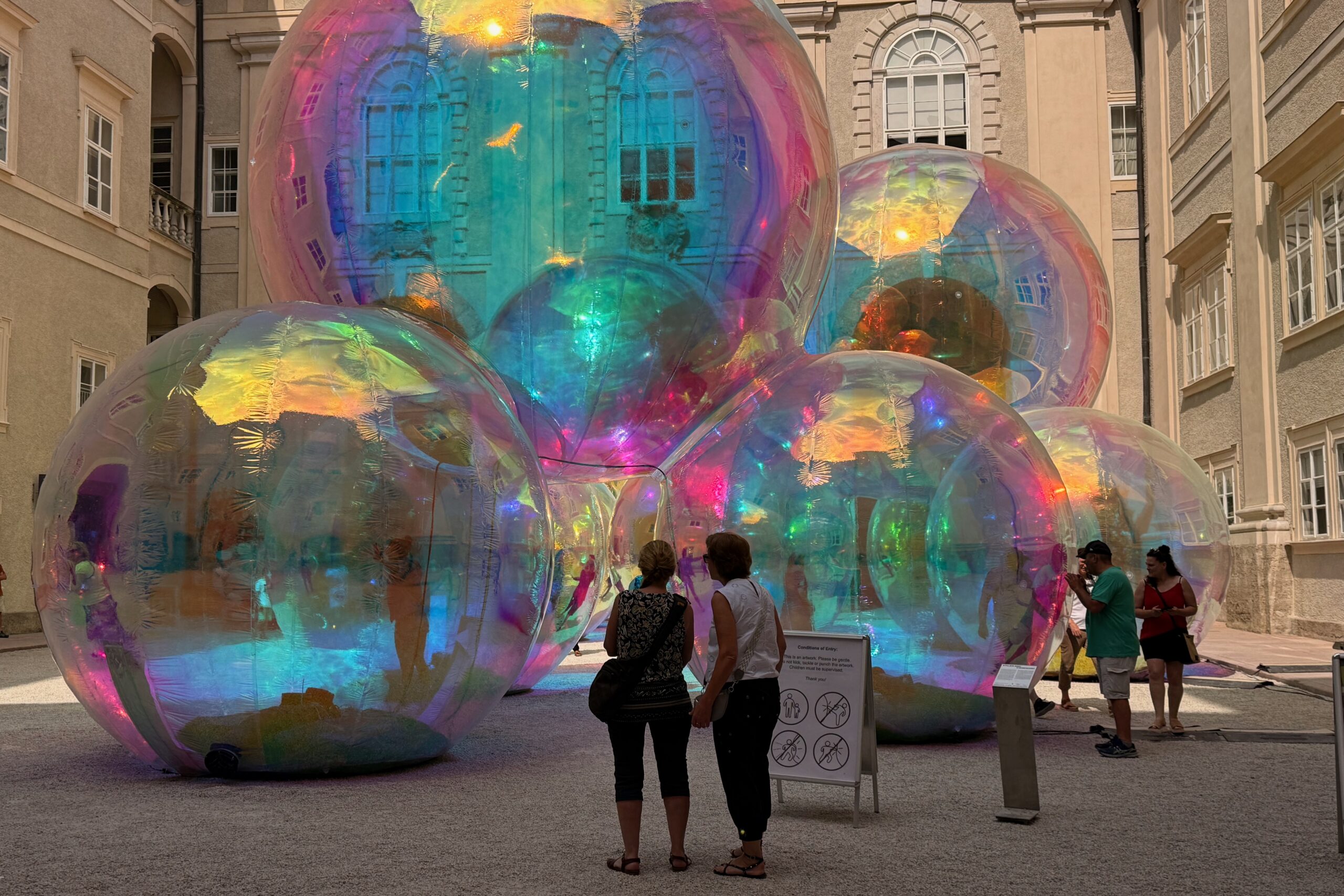
Salzburg feels improbably composed. The river moves quietly through the center, church domes rise against Alpine cliffs, and entire streets appear almost too symmetrical to belong to a real place rather than a stage set. Yet the city becomes more interesting once you notice the tension beneath that beauty: Salzburg was built through immense religious wealth, shaped by music and trade, and confined for centuries between mountains that forced it inward rather than outward. A solo traveler notices that intimacy differently.
The History of Salzburg: How It Became What It Is
Salzburg’s beauty can make it easy to underestimate how unusual its history actually is. Long before Mozart postcards and Sound of Music tourism, the city grew rich through salt. The name Salzburg literally means “Salt Castle,” and for centuries the surrounding salt mines financed one of the wealthiest ecclesiastical states in Europe. What survives today is not simply an attractive old town but the architectural result of extraordinary concentrated power.
The Salt City Beneath the Mountains
Salzburg emerged as an important settlement because of the Salzach River and nearby salt deposits, which were already being exploited in Roman times. By the Middle Ages, the city’s prince-archbishops controlled the lucrative salt trade across the region, turning Salzburg into a wealthy religious principality within the Holy Roman Empire. That wealth still explains much of the city’s physical appearance today. The massive Hohensalzburg Fortress dominating the skyline was expanded significantly beginning in 1077 during the Investiture Controversy, when church leaders across Europe fortified themselves against political instability. Unlike many medieval cities, Salzburg’s rulers invested heavily in religious grandeur and urban planning rather than commercial expansion alone. Walking through the Altstadt today, the city still feels unusually controlled architecturally because so much of it developed under centralized ecclesiastical authority.
Baroque Ambition and the Mozart Myth
Much of the Salzburg visitors recognize today emerged after a devastating fire in 1598 destroyed large parts of the city. Italian architects were brought north, and Salzburg was rebuilt in a striking Baroque style more commonly associated with Rome than Alpine Austria. Domes, ornate squares, monastery complexes, and symmetrical façades transformed the city into what many historians describe as the “German Rome.” The Salzburg Cathedral became the clearest expression of this ambition.
Then came Mozart. Born in Salzburg in 1756, Wolfgang Amadeus Mozart permanently altered how the world perceived the city, even though his relationship with it was often deeply frustrated. Salzburg celebrates Mozart constantly now, but the irony matters: the composer spent much of his life trying to escape what he viewed as a provincial and restrictive court culture. That contradiction still shapes the city’s atmosphere today. Salzburg balances refinement with restraint, performance with discipline.
The Modern City Between Tourism and Preservation
The 20th century reshaped Salzburg again, particularly after World War II, when the city increasingly positioned itself around culture and international tourism. The Salzburg Festival, founded in 1920 by figures including Max Reinhardt and Hugo von Hofmannsthal, became one of Europe’s most prestigious performing arts festivals and helped redefine Salzburg globally as a center of classical music and theater.
Yet Salzburg avoided some of the aggressive modernization that transformed larger European cities after the war. Its UNESCO-listed historic center remains remarkably intact partly because geography limited outward expansion. The surrounding Alps still frame the city tightly. Modern Salzburg therefore feels unusually preserved without becoming entirely frozen. Local cafés still function as everyday meeting places rather than staged attractions, and residential life continues inside streets that millions photograph each year.
What Makes Salzburg Distinct: Character, Culture & the Solo Experience
Salzburg moves differently from larger European capitals. Vienna expands outward. Munich spreads into neighborhoods. Salzburg folds inward. The mountains constantly narrow your perspective back toward the river, the churches, the fortress, and the old streets below. That geographical intimacy changes how the city feels alone. Distances remain walkable, transitions happen naturally, and wandering rarely becomes exhausting.
The city’s relationship with beauty is also unusually deliberate. Salzburg often appears highly curated, but not artificially so. Window displays, pastry counters, church interiors, public gardens, and café terraces all reflect a culture that values presentation without necessarily making a spectacle of it. Even traditional Austrian coffee house culture operates differently here than in larger cities. People linger quietly. Public life feels observant rather than loud.
Solo travelers often experience Salzburg more fully because the city rewards slowness instead of accumulation. There are fewer major “must-see” landmarks than in Vienna, Rome, or Paris, which changes the psychological pace of being there. You notice details more easily: the sound of church bells echoing against the cliffs, early-morning fog over the Salzach, the contrast between formal Baroque architecture and surrounding Alpine scenery.
Salzburg also occupies a distinctive position within Austria itself. It feels culturally Austrian, unmistakably Catholic in historical identity, and deeply connected to classical music traditions, yet the surrounding Alpine landscape softens the city’s formality. That balance makes it especially approachable for independent travelers. Even during busy periods, Salzburg rarely feels emotionally overwhelming in the way larger historic cities sometimes can.
For travelers already exploring Central Europe, Salzburg also creates an interesting contrast with nearby destinations. A related internal read worth exploring is the Munich solo travel guide, particularly because the two cities share intertwined Bavarian and Austrian cultural histories while feeling entirely different atmospherically.
Places That Tell Salzburg’s Story
Hohensalzburg Fortress towers above the city as one of the largest fully preserved medieval castles in Europe. More than a military structure, it reflects centuries of prince-archbishop authority and reminds visitors how deeply religion and political power once overlapped in Salzburg.
Salzburg Cathedral expresses the city’s transformation into a Baroque religious center after the 1598 fire. Its scale and Italian-inspired design reveal how Salzburg’s rulers used architecture to project cultural sophistication far beyond what many would expect from an Alpine city.
Getreidegasse preserves the commercial spine of the old city, where wrought-iron guild signs still hang above narrow passageways. The street explains how Salzburg functioned historically not just as a religious center but as an active trading city connected to broader European networks.
Mozart’s Birthplace demonstrates how completely one historical figure can reshape a city’s global identity. Yet the modest scale of the building itself also reveals the smaller, court-centered Salzburg that Mozart often found limiting during his early life.
Mirabell Palace and Gardens tell the story of Salzburg’s Baroque ambition more clearly than almost anywhere else in the city. Designed originally by Prince-Archbishop Wolf Dietrich for Salome Alt, the palace reflected both political status and deeply personal scandal within ecclesiastical society.
St. Peter’s Abbey and Cemetery embody Salzburg’s continuity across centuries. The abbey dates back to the 7th century, and the surrounding cemetery, carved partly into the rock face beneath the fortress, makes Salzburg’s relationship with faith, memory, and landscape feel unusually tangible.
Why Salzburg Rewards the Solo Traveler
Salzburg rewards solo travelers because the city naturally encourages reflection. Larger cities often pressure visitors into constant movement, but Salzburg operates differently. The physical scale remains manageable, the rhythm stays relatively calm, and the city reveals itself gradually through repetition rather than intensity.
A person traveling alone also notices Salzburg’s atmosphere more clearly because so much of the experience is sensory rather than logistical. Church bells mark the hour across the old town. The mountains alter the evening light earlier than expected. Café interiors remain quiet enough to sit alone comfortably without feeling conspicuous.
The city is especially rewarding during spring, when Salzburg begins reopening outward after winter and the surrounding Alpine landscape softens into green again. At that time of year, walking alone along the Salzach River or through the Mirabell Gardens feels less like sightseeing and more like briefly participating in the city’s everyday rhythm.
Most importantly, Salzburg does not require performance from the traveler. You do not need to rush, optimize, or conquer it. The city works best when approached patiently — exactly the kind of pace solo travel often makes possible.
48 HOURS IN SALZBURG — THE GUIDE
This article explains Salzburg. The guide shows you how to move through it properly, with an hour-by-hour structure built around crowd timing, fortress routing, realistic walking flow through the Altstadt, Salzburg Card strategy, traditional beer hall recommendations, Alpine viewpoint timing, and an interactive map designed specifically for independent travelers.
Ready to Go?
Salzburg becomes more rewarding once you stop treating it as simply a beautiful stop between larger European cities. Slow down enough to notice how the river divides the old town, how the mountains contain the city, and how centuries of religious, artistic, and Alpine influence still shape everyday life here.
48-Hour City Guides
Ready to Go? Grab Your Guide.
Hour-by-hour itineraries built for independent travelers.
London, Paris, Vienna, Prague, Amsterdam and more — $7.99 each.
