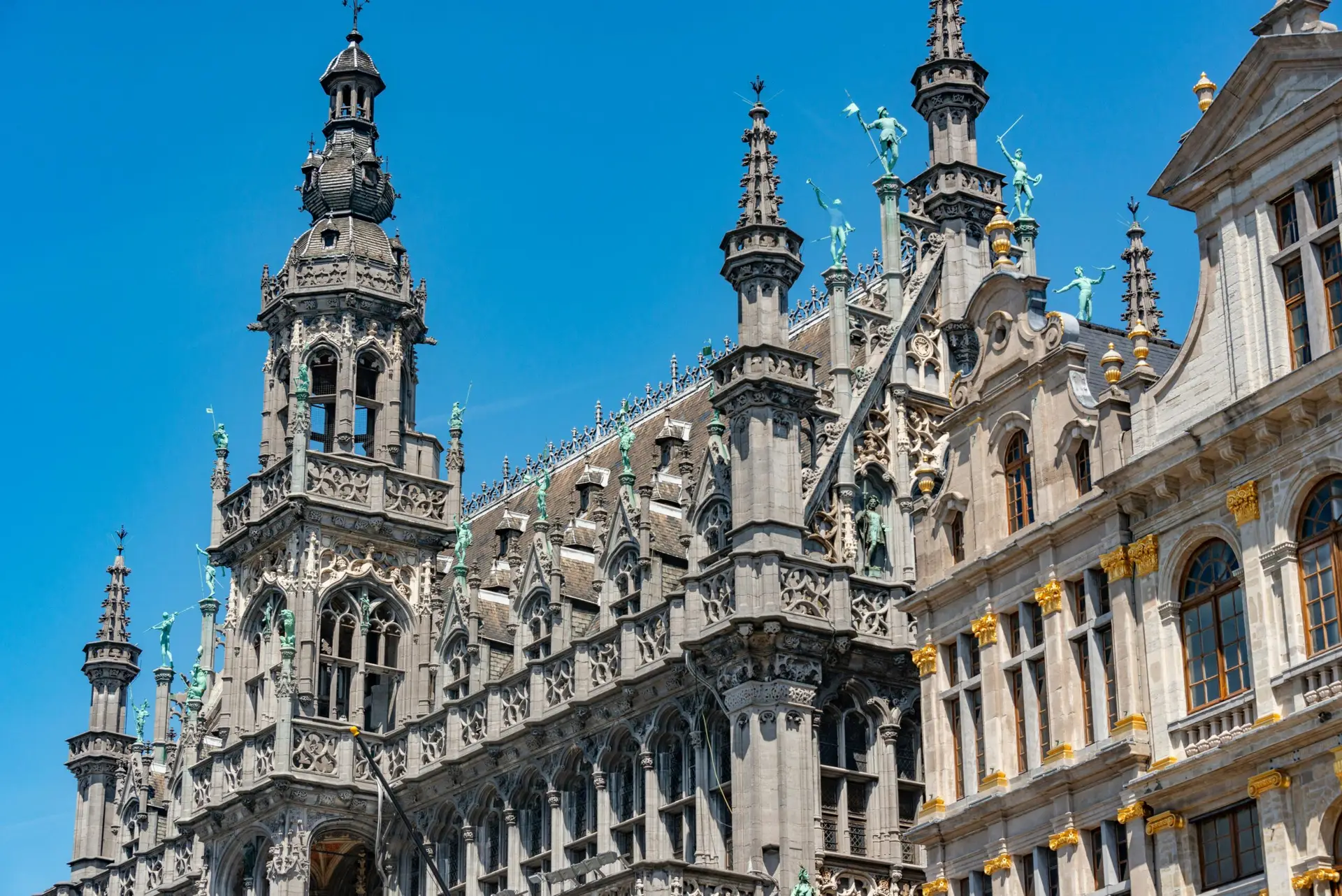
Brussels is a city that has spent centuries being strategically located and therefore strategically contested—a fact visible in everything from the architecture of its Grand-Place (rebuilt in defiance after Louis XIV’s artillery shelled it in 1695) to the pragmatic bilingualism that means every street sign reads in two languages and every conversation begins with a quiet negotiation over which one. For anyone embarking on a solo travel adventure in Brussels, that complexity is not an obstacle; it’s what makes the city genuinely interesting once you stop expecting it to be simple.
The History of Brussels: How It Became What It Is
Brussels is the story of a city shaped by empire. Three distinct historical moments explain the architecture, language, and culture you encounter today.
Founded in the Marsh: How Brussels Became a Capital
Brussels began as Broeksele (Old Dutch for “settlement in the marsh”), a trade crossroads on the River Senne. Its rise to power was a dynastic accident. In the early 16th century, Habsburg Emperor Charles V made Brussels the administrative center of the Low Countries, importing his entire imperial apparatus.
The prosperous local guilds suddenly found themselves hosting an empire. The Grand-Place’s ornate guildhalls—rebuilt after French shelling in 1695—reflect that intense civic pride: competitive, theatrical, and deeply self-important.
The Empire’s Inheritance: From Habsburgs to Revolutionaries
The modern Belgian state was born recently, declared in 1830 after centuries of foreign rule by the Spanish, Austrians, French, and Dutch. The newly independent nation built its capital with theatrical ambition, creating a rich backdrop for a Brussels travel itinerary.
Later, King Leopold II used the profits of his personal colony in the Congo to reshape Brussels. He funded wide boulevards, the Cinquantenaire’s triumphal arch, and monumental parks. Today, the city is finally reckoning with this colonial wealth, a shift visible in the updated Africa Museum in Tervuren. Navigating these complex historical layers on foot makes exploring Brussels incredibly rewarding.
The 20th Century: From Art Nouveau to the Seat of Europe
Brussels entered the 20th century as the Art Nouveau capital of the world — Victor Horta’s revolutionary buildings were redefining what architecture could do with iron, glass, and light. Then it endured two German occupations in the space of thirty years. The decision to make Brussels the seat of the emerging European Community in the 1950s was both a diplomatic calculation and an act of post-war optimism: a continent organizing itself after two catastrophic wars chose as its administrative home a city that had been fought over by most of them.
The EU Quarter that resulted — alongside the NATO headquarters in Evere — brought 30,000 Eurocrats and diplomats into the fold, creating a second city-within-the-city operating on its own distinct schedule. Because the Brussels of the Grand-Place and the Brussels of the Schuman roundabout are five kilometers apart and feel like completely different countries, a solo travel Brussels journey allows you the unique freedom to step between these contrasting worlds entirely at your own pace.
What Makes Brussels Distinct: Character, Culture & the Solo Experience
Brussels does not make an obvious first impression. While the Grand-Place astonishes, the rest of the center can feel caught between tourist traps and sterile administrative blocks. The real city reveals itself on a second impression: the morning flea market in the Marolles, the smell of Wittamer’s pastry in the Sablon on a Saturday, or the quiet canal-side streets of Molenbeek. Its true texture is found at street level.
Belgium’s relationship to pleasure is modest but serious. Beer is not a gimmick; breweries like Cantillon still use spontaneous fermentation methods unchanged for generations. Chocolate follows the same high standard. The praline was invented here in 1912, and the quality gap between master chocolatiers like Pierre Marcolini and tourist-trap kiosks is massive.
The city’s natural bilingualism makes it an easy place to be a stranger. Locals are entirely used to linguistic uncertainty. Combined with a café culture that welcomes solo diners and a pace that doesn’t perform for tourists like Paris or Amsterdam, Brussels is uniquely comfortable for solo travelers.
Places That Tell Brussels’s Story
-
The Grand-Place: After French shelling destroyed the square in 1695, local guilds rebuilt it within five years. The resulting ornate style was a collective act of defiance against French imperial power. Visit at 7:00 AM to experience the empty square before the crowds arrive.
-
The Galeries Royales Saint-Hubert: Opened in 1847, this was Europe’s first covered shopping arcade, inspiring famous variants in Milan and Moscow. Today, it still houses a historic cinema, the 1912 birthplace of the Neuhaus praline, and locals seeking refuge from the elements.
-
The Magritte Museum: This five-floor collection features 250 chronological works. More than just a biography, it reflects Belgium’s unique relationship with the absurd—an ironic perspective developed to survive a turbulent 20th century.
-
The Cantillon Brewery: Located in Anderlecht, this is the last traditional lambic brewery in Brussels. It uses spontaneous fermentation in a building unchanged since 1900, proving that Belgian beer is a distinct global tradition.
-
The Marolles: The flea market at Place du Jeu de Balle has run since the mid-19th century. As the birthplace of Brusseleir—the city’s nearly extinct bilingual dialect—this neighborhood has successfully resisted gentrification through sheer character.
Why Brussels Rewards the Solo Traveler
Brussels rewards the traveler who wanders without an agenda. It is a city where the true pleasure lies in daily life rather than in monument queues. Café culture treats solo diners as entirely normal. A person alone at a table in the Sablon or Place Flagey is never a curiosity, allowing solo itineraries to naturally shift from rigid sightseeing to authentic local immersion.
The city’s scale makes exploration easy. Brussels features distinct neighborhoods—like the Art Nouveau streets of Saint-Gilles or the lakeside quiet of Ixelles—, yet a tram ride between them takes just twenty minutes. You can visit the Grand-Place in the morning and spend the afternoon in a neighborhood untouched by tourism. This compact layout makes solo travel efficient and highly customizable on the fly.
Because Brussels is used to people from elsewhere, there is no pressure to fit a predefined tourist mold. The city doesn’t perform for visitors, but it doesn’t ignore them either. Once the Grand-Place is behind you, this combination of cosmopolitan ease and genuine local depth is exactly what you will find.
48 HOURS IN BRUSSELS — THE GUIDE
The 48 Hours in Brussels guide takes this history and turns it into a precise 48-hour sequence: specific neighborhoods in the right order, exact restaurants with prices, transport logistics from the airport to every stop on the itinerary, backup plans for rain, and an interactive map with every location color-coded by day. It is the operational tool that turns knowing Brussels into actually experiencing it.
Get the 48 Hours in Brussels guide → $7.99
Browse all 48-Hour Guides at GoingSolo.Life/guides/
Ready to Go?
Brussels doesn’t announce itself. It waits for you to slow down enough to notice the flea market at 8 am, the gueuze on the bar at Moeder Lambic, the Magritte that stops you in front of it, and refuses to let you move on. None of that requires company.
48-Hour City Guides
Ready to Go? Grab Your Guide.
Hour-by-hour itineraries built for independent travelers.
London, Paris, Vienna, Prague, Amsterdam and more — $7.99 each.
