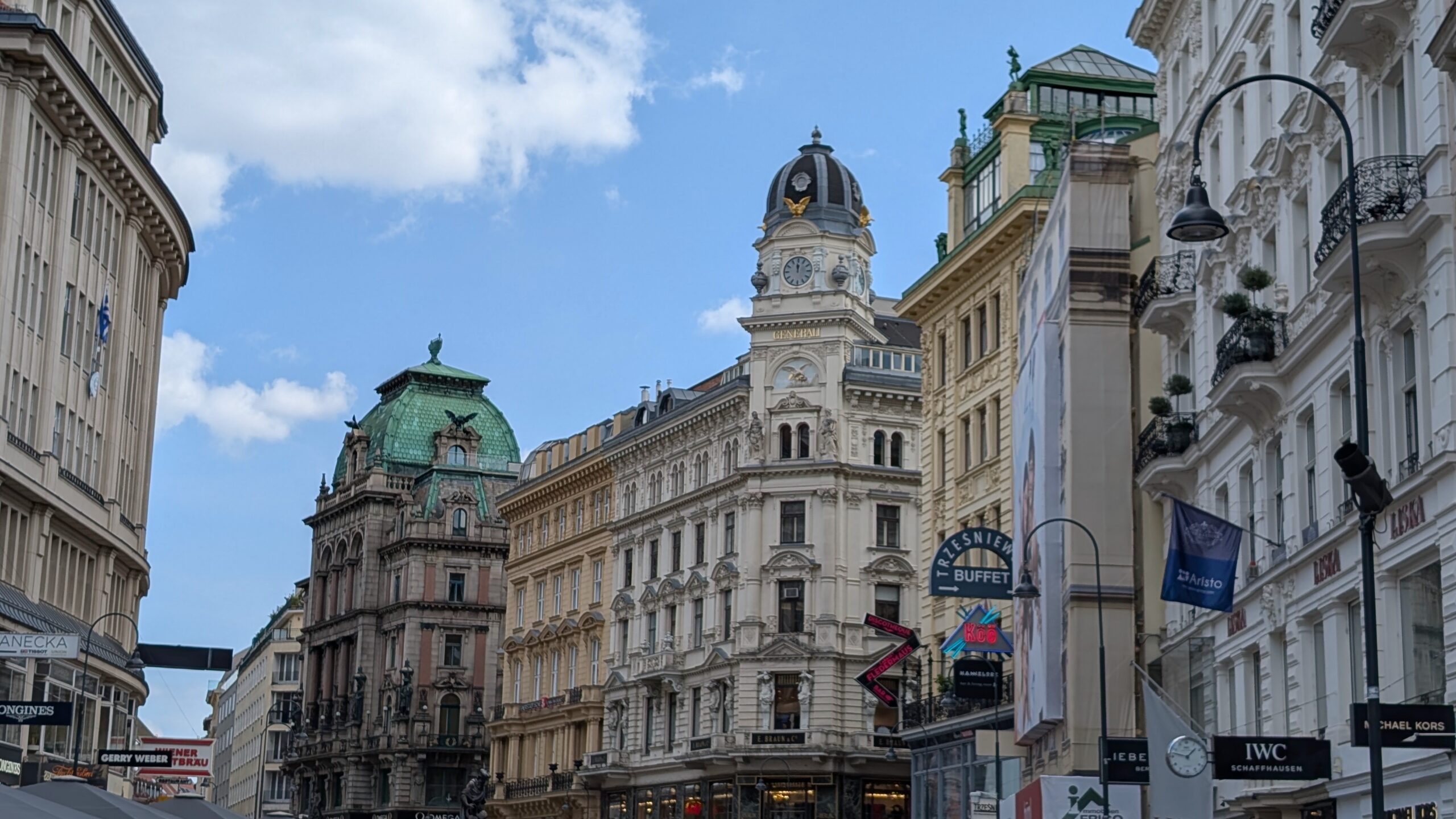
Vienna does not reveal itself through noise. It works more quietly than that: in polished stone courtyards, long coffee house pauses, grand streets built to make power visible, and public spaces where history still feels close enough to touch. For a solo traveler, that restraint becomes part of the pleasure; Vienna gives you room to notice what groups often rush past.
The History of Vienna: How It Became What It Is
Vienna began at a frontier. Long before the palaces, opera houses, and chandeliered cafés, the Romans built Vindobona on the Danube edge of their empire. That borderland position mattered. Vienna was never just decorative; it was strategic, placed between western Europe, the Balkans, the German-speaking world, and the river routes that carried trade, armies, ideas, and risk. UNESCO notes that the city grew from Celtic and Roman beginnings into a medieval and Baroque capital, later becoming the seat of the Austro-Hungarian Empire.
When the Empire Came Indoors
The Habsburgs turned Vienna into a capital of rooms, rituals, and controlled grandeur. The Hofburg was their seat for more than 600 years, expanding across centuries into a palace complex rather than one single building. That explains why central Vienna can feel layered instead of planned: medieval lanes sit near imperial gates, court churches, museums, libraries, and ceremonial squares. The city’s power was not announced in one monument. It accumulated, wing by wing, dynasty by dynasty, until the center became a physical record of rule.
The Ringstrasse and the City That Performed Itself
In the 19th century, Vienna made one of its boldest decisions: it demolished its old city walls and replaced them with the Ringstrasse, the grand boulevard that still frames the historic core. The project followed an imperial decree under Franz Joseph and turned former fortifications into theaters, museums, parliament buildings, parks, and civic monuments. This is why Vienna feels unusually theatrical. The Ring was not merely a road. It was a statement that empire, culture, and modern city life could occupy the same stage.
The 20th Century Beneath the Elegance
Vienna’s beauty can make its 20th century feel deceptively distant, but it remains close. After the Austro-Hungarian Empire collapsed in 1918, Vienna became capital of a much smaller republic. Interwar “Red Vienna” then built one of Europe’s most ambitious municipal housing programs, with tens of thousands of public flats created between 1919 and 1934. After Nazi annexation, war, and Allied occupation, Austria regained full sovereignty with the State Treaty signed at the Belvedere on May 15, 1955. That history gives Vienna its unusual tension: imperial polish, social-democratic practicality, and postwar restraint sharing the same streets.
What Makes Vienna Distinct: Character, Culture & the Solo Experience
Vienna has a formal surface, but it is not an unfriendly city. Its manners are structured. Greetings matter. Coffee is not rushed. Public life has a rhythm that rewards patience rather than performance. The city values order, but it also values time — time to sit, read, walk, think, and let a room or street do its work.
The coffee house remains the clearest expression of that character. Austria’s UNESCO inventory describes Viennese coffee house culture through marble-topped tables, Thonet chairs, newspaper tables, historic interiors, and the famous idea that “time and space are consumed, but only the coffee is listed on the bill.” For solo travelers, that matters. A table for one does not feel like a compromise here. It feels entirely natural.
Vienna also carries culture without forcing it into spectacle. Music, painting, architecture, psychoanalysis, literature, and politics all left marks here, but the city rarely begs for attention. It expects you to look properly. That makes it ideal for independent travelers who enjoy connecting details: a palace façade, a municipal housing block, a Klimt painting, a quiet tram ride, a café table that has held a century of conversations.
Places That Tell Vienna’s Story
Stephansdom: St. Stephen’s Cathedral anchors the Innere Stadt both physically and symbolically, its Gothic tower still cutting through the skyline of the old city. It tells the story of Vienna before empire became architecture: a medieval city built around faith, trade, and survival.
The Hofburg: The Hofburg was the Habsburgs’ central residence for centuries, expanded so many times that it now reads like a map of dynastic ambition. To understand Vienna’s imperial character, you need to see how power here was not placed in one palace but spread through courtyards, gates, chapels, libraries, and ceremonial rooms.
The Ringstrasse: The Ringstrasse replaced the demolished city walls with a boulevard of museums, theaters, civic buildings, and monuments. It tells you how 19th-century Vienna wanted to be seen: cultured, modern, imperial, and completely aware of its own image.
Schönbrunn Palace: Schönbrunn is one of Europe’s great Baroque palace-and-garden ensembles and a material symbol of Habsburg power across centuries. Away from the old center, it shows how the dynasty staged private life with the same confidence it brought to politics.
The Belvedere: The Belvedere connects Baroque aristocratic Vienna with the city’s modern artistic identity. Its role in Austria’s 1955 State Treaty also gives it a second meaning: not just a palace of art, but a setting where the postwar country stepped back into sovereignty.
Vienna’s Coffee Houses: The classic coffee house is not simply a place to drink coffee. It is one of Vienna’s great social inventions: part salon, part reading room, part refuge, and one of the easiest places for a solo traveler to feel fully at home.
Why Vienna Rewards the Solo Traveler
Vienna works beautifully alone because it gives solitude a civic setting. You can sit in a coffee house without feeling watched, walk the Ring without needing conversation, study a painting without being pulled onward, and move through the city at a pace that feels personal rather than scheduled.
There is also something quietly empowering about Vienna for independent travelers. The city does not demand constant decision-making. Its center is compact, its cultural identity is strong, and its public spaces invite attention. You are not chasing the city; you are reading it. And Vienna is at its best when read slowly.
48 HOURS IN VIENNA — THE GUIDE
This article gives you the context. The guide turns that context into a real trip, with an hour-by-hour sequence, exact museum timing, coffee house strategy, restaurant picks with prices, transport tips, backup plans, and insider moves designed specifically for solo travelers.
Ready to Go?
Vienna rewards travelers who arrive curious rather than rushed. Come prepared to look closely, sit longer than planned, and let the city’s history show itself in layers.
Browse all the 48-Hour Guides today— 12 European cities and counting.
48-Hour City Guides
Ready to Go? Grab Your Guide.
Hour-by-hour itineraries built for independent travelers.
London, Paris, Vienna, Prague, Amsterdam and more — $7.99 each.
