
Generic “top 10 sights” lists were never designed with you in mind. If you’ve ever followed a standard city guide only to find yourself shuffling through crowded museums feeling vaguely disconnected, you’re not alone. Solo travelers over 50 bring a different set of priorities to the table: depth over volume, connection over spectacle, and personal rhythm over a packed schedule. This guide walks you through every stage of building a custom itinerary that actually fits your life, your pace, and your curiosity, so that your next city trip feels genuinely yours from the first morning coffee to the last evening stroll.
Table of Contents
- What you need to start a custom itinerary
- Step-by-step custom itinerary planning
- How to prioritize authentic local experiences
- Final checks: Test and adapt your itinerary
- Why conventional itinerary planning misses the mark after 50
- Ready to explore? Get started with our solo travel resources
- Frequently asked questions
Key Takeaways
| Point | Details |
|---|---|
| Preparation is key | Gather the right tools, resources, and flexible mindset before planning your trip. |
| Immersion over sightseeing | Prioritize activities that foster local connections rather than a checklist of attractions. |
| Step-by-step planning | Follow a clear process to create, test, and refine custom itineraries for authentic experiences. |
| Adapt for comfort | Your plans should align with your abilities, interests, and allow space for rest and spontaneity. |
| Leverage resources and community | Use trusted guides and traveler communities to discover authentic opportunities and advice. |
What you need to start a custom itinerary
Now that you know why a custom approach is vital, let’s look at what you need before diving into planning.
Before you open a single travel website, gather the raw materials that will shape your trip. Think of this as your pre-planning toolkit. The better your inputs, the better your itinerary.
Your planning toolkit
| Tool or resource | What it’s for | Where to get it |
|---|---|---|
| Travel dates and duration | Anchors all logistics | Your calendar |
| Mobility and comfort notes | Shapes activity choices | Personal assessment |
| Interest list (food, art, history, nature) | Drives experience selection | Journaling or brainstorm |
| City map (offline capable) | Navigation without data | Google Maps offline or Maps.me |
| Local language basics | Builds rapport with locals | Duolingo, phrasebook |
| Health info and medications | Safety and contingency planning | Your doctor |
| Essential travel apps | Booking, translation, transit | App store |
Start by writing down your travel dates, then honestly assess your physical comfort level. Can you walk three miles on cobblestones? Do stairs bother your knees? These aren’t limitations, they’re simply data points that help you design a smarter day. Cultural immersion supports social and cognitive benefits while also accommodating the physical abilities of older travelers, which means your itinerary can be both meaningful and comfortable at the same time.
Next, write your interest list. Be specific. “History” is vague. “Medieval architecture and local food markets” gives you something to search for. Specificity is what separates a custom itinerary from a generic one.
Mindset tips for flexible, immersive travel:
- Accept that you won’t see everything, and that’s a feature, not a flaw
- Treat unexpected detours as part of the experience
- Build in breathing room so you’re not rushing between sites
- Stay curious about people, not just places
- Allow yourself to return to a spot you loved instead of always moving forward
Pro Tip: Before you finalize your trip length, consider adding an extra night at your destination. That buffer day often becomes the best one, because you’re relaxed enough to wander without an agenda. It also gives you a safety net if a physical limitation or weather issue disrupts your original plan.
Step-by-step custom itinerary planning
Once you’re prepared, follow these steps to actually craft your unique travel plan.
Building your itinerary is a creative process, but it helps to follow a clear sequence. Here’s the method we recommend for solo travelers over 50 who want immersive, authentic experiences rather than a checklist sprint.
The five-step planning process
- Research deeply, not broadly. Instead of scanning every travel blog, pick two or three trusted sources and go deep. Look for neighborhood-level recommendations, not just city-wide highlights. Search for local food markets, community festivals, independent bookshops, and artisan workshops. AI itinerary planning tools can help you generate a solid first draft quickly, which you then personalize based on your interests and pace.
- Shortlist experiences by category. Group your discoveries into categories: morning walks, cultural sites, food experiences, rest spots, and evening options. Aim for two or three solid options per category per day. This gives you flexibility without leaving you staring at a blank afternoon.
- Map your days geographically. Cluster activities by neighborhood so you’re not crisscrossing the city. A morning in the old quarter, an afternoon in the market district, and an evening near your hotel makes for a far more relaxed day than hopping across town between every stop. Use your offline map to visualize the flow.
- Confirm logistics in advance. Check opening hours, reservation requirements, and accessibility details for every key stop. Many smaller cultural sites, cooking classes, and local tours require advance booking, especially in peak season. Don’t assume walk-ins are always possible.
- Plan intentional downtime. This is the step most travelers skip. Schedule at least 90 minutes of unstructured time each day. Sit in a plaza. Have a second coffee. Let a conversation with a shopkeeper run long. Immersive, authentic experiences happen when you move beyond sightseeing checklists and leave room for real life to enter your day.
Generic vs. custom itinerary: a side-by-side comparison
| Element | Generic itinerary | Custom immersive itinerary |
|---|---|---|
| Activity selection | Top-rated tourist sites | Chosen based on personal interests |
| Pacing | Packed, back-to-back | Balanced with rest and flexibility |
| Food choices | Recommended restaurants near sites | Local markets, neighborhood trattorias |
| Social interaction | Minimal, mostly transactional | Intentional, with locals and small groups |
| Physical comfort | One-size-fits-all | Adapted to your mobility and stamina |
| Spontaneity | Little room for detours | Built-in unscheduled time every day |
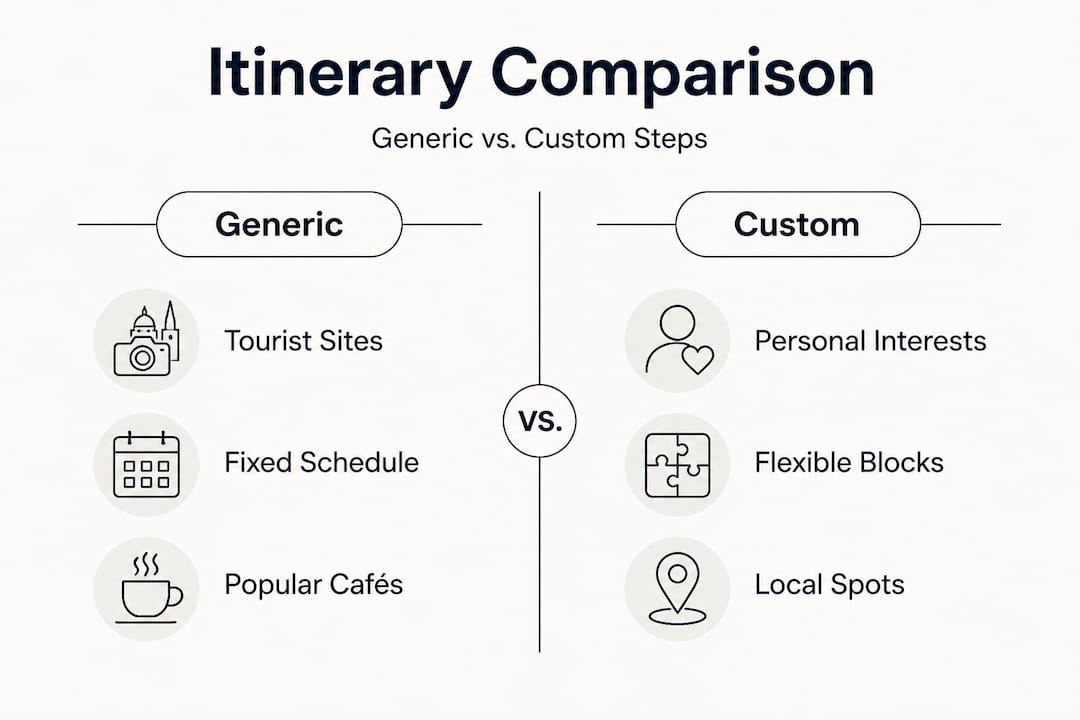
The difference is stark. A custom itinerary treats you as an individual, not a tourist category. You can explore our 48-hour city guides as a starting framework and then layer in your own priorities on top.
Pro Tip: Block out one slot per day labeled “local interaction time.” Use it to visit a neighborhood café, browse a community market, or simply ask a local shopkeeper what they recommend. These moments often become the stories you tell when you get home.
How to prioritize authentic local experiences
With your draft itinerary in hand, make sure the experiences you include will actually deliver authenticity and enrichment.

Not all “local” experiences are created equal. A tourist-facing cooking class in a polished kitchen is very different from joining a small neighborhood food tour led by a resident. Here’s how to tell them apart and choose wisely.
Criteria for genuinely authentic opportunities
- Home-cooked or family-run meals: Look for restaurants where the owner is also the cook, or seek out supper clubs and social dining events hosted by locals
- Skills-based local classes: Pottery, weaving, bread-making, language lessons taught by neighborhood residents
- Neighborhood markets: Weekly or daily markets where locals actually shop, not just tourist-facing stalls
- Community festivals and religious events: Check local event calendars for dates that coincide with your visit
- Volunteer or cultural exchange programs: Short-term opportunities to contribute something while you learn
“Immersion involves building relationships, sharing meals, and participating in local routines, not just replacing one landmark with another.” — Cultural Immersion Experiences: A Senior’s Guide to Authentic Local Living
This distinction matters. Real immersion means you’re a participant, not a spectator. When you sit down for a meal in someone’s home or join a local class, you’re building a brief but genuine human connection. That’s what stays with you long after the trip ends.
Engaging with locals in this way also carries measurable benefits. Cultural immersion supports cognitive health and social wellbeing for mature travelers, making it one of the most rewarding investments you can make with your travel time.
How to vet activities for authenticity
Start with community boards and local Facebook groups for the city you’re visiting. Residents often share recommendations that never appear on mainstream travel sites. Read recent reviews carefully and look for comments from local visitors, not just tourists. Travel blogs written by long-term residents or expats are another excellent source. For cultural day trips and history-focused outings, our guide to cultural day trips from Barcelona is a good example of how to research beyond the obvious.
If you’re heading to a destination for the first time, our first solo trip lessons offer honest, practical advice on navigating unfamiliar territory with confidence.
Final checks: Test and adapt your itinerary
Before you pack your bag, it’s crucial to run these real-world checks on your plan.
You’ve built something solid. Now stress-test it. A few hours of careful review before you leave can save you from frustrating surprises on the ground.
Final review process
- Walk through each day out loud. Narrate your day from wake-up to bedtime. Does the pacing feel realistic? Are you trying to fit too much into a single afternoon?
- Check all opening hours and reservation confirmations. Do this again, even if you checked during the research phase. Hours change, especially around local holidays.
- Identify your rest points. Every day should have at least one built-in rest stop, a bench in a park, a café with good seating, or a quiet museum courtyard. Adapting for comfort and ability means choosing pacing that genuinely works for your physical needs, not just what looks good on paper.
- Save local contact numbers. Your hotel, a local taxi service, the nearest pharmacy, and any tour operators you’ve booked. Keep these in your phone and on paper.
- Build in one completely free half-day. Leave one morning or afternoon with nothing scheduled. Use it for whatever feels right when you’re there.
Common mistakes to avoid
- Over-scheduling: Fitting six activities into a single day leaves no room for the unexpected, and the unexpected is often the best part
- Ignoring local holidays and closures: Many smaller cultural sites close on Mondays or for local festivals
- Skipping downtime: Fatigue accumulates fast when you’re traveling solo, and there’s no one to slow you down except yourself
- Forgetting transit time: Walking 20 minutes between sites sounds easy at home but feels very different after a full morning of exploring
- Locking in every meal: Leave at least one meal per day open so you can follow a recommendation you pick up along the way
If you’re unsure about safety, logistics, or local customs, it may be worth consulting a specialist. Our post on travel advisor insights explains when professional guidance adds real value and when you can confidently go it alone.
Why conventional itinerary planning misses the mark after 50
Having your itinerary ready, it’s worth reflecting on what truly matters in travel after 50.
Most travel guides are still written for a version of you that wants to see as much as possible in as little time as possible. That model made sense at 28. It doesn’t serve you as well now, and honestly, it probably never did.
The standard approach treats a city like a menu to be consumed. See the cathedral, photograph the bridge, eat at the famous restaurant, move on. There’s nothing wrong with any of those things individually. The problem is the mindset behind them, the idea that more equals better, and that you’ve somehow “done” a city once you’ve ticked its landmarks.
After 50, most of us have traveled enough to know that the moments we remember most vividly aren’t the famous sights. They’re the afternoon we spent talking to a retired schoolteacher in a village bar. The morning we stumbled into a neighborhood bakery before it opened to tourists. The evening we joined a local family’s table at a festival because someone simply waved us over.
Immersion brings benefits beyond sightseeing, especially for mature solo travelers. It sharpens your thinking, lifts your mood, and creates the kind of memories that don’t fade. None of that happens when you’re racing between landmarks with a guidebook in hand.
We’d encourage you to give yourself permission to miss a top-rated site if something more interesting presents itself. The Uffizi will be there next time. The conversation with the glassblower who invites you into his workshop probably won’t. That’s the real shift in thinking that separates a meaningful trip from a forgettable one.
GoingSolo.life is built around this philosophy. Every guide, tip, and resource we offer is designed to help you travel more deeply, not more frantically.
Ready to explore? Get started with our solo travel resources
You’ve got the framework. Now let’s put it into action with tools built specifically for travelers like you.
At GoingSolo.life, everything we create is designed for independent solo travelers over 50 who want real experiences, not tourist theater. Our 48-Hour Guides give you a tightly curated starting point for dozens of European and American cities, saving you hours of research while leaving plenty of room for your own discoveries. Pair them with our solo travel app picks to stay organized, connected, and confident on the ground. And if you want hands-on support building a plan that fits your specific interests and pace, our custom itinerary support resources are ready when you are. Your next meaningful adventure is closer than you think.
Frequently asked questions
What is the best way to find authentic cultural activities for my itinerary?
Cultural immersion requires active participation through shared meals and local customs, so intentionally include those experiences and vet options by checking community boards and trusted travel blogs rather than relying solely on mainstream review sites.
How can I make sure my itinerary fits my physical comfort level?
Test your plans for realistic pacing, choose accessible activities, and always have backup options for rest or transportation. Itineraries can accommodate physical abilities and ensure genuine comfort when you plan honestly rather than optimistically.
Do I need a travel advisor to plan a custom itinerary as a solo traveler over 50?
A travel advisor can offer valuable insights and safety tips, but many travelers over 50 plan successfully with proper research and trusted guides. Expert advice enhances solo travel planning, but personal research combined with good resources is genuinely powerful on its own.
How much flexibility should I build into my itinerary for local discoveries?
Leave some unscheduled time each day so you can say yes to serendipity and immersive invitations from locals. Intentional flexibility supports deeper local engagement and creates space for the authentic experiences that make a trip memorable.
Is it safe to join meals with locals or try a homestay when traveling solo?
Joining meals or homestays is safe when arranged through well-reviewed, reputable platforms and by trusting your instincts. Well-organized local immersion activities benefit senior travelers and can be done safely with a little advance research and common sense.
Recommended
- How I Plan a Trip With AI in 48 Hours – Going Solo Life Travel
- What I Wish I’d Known Before My First Solo International Trip – Going Solo Life Travel
- Content Creation Archives – Going Solo Life Travel
- The Travel Apps I Never Go Without as a Solo Traveler – Going Solo Life Travel
Article generated by BabyLoveGrowth
48-Hour City Guides
Ready to Go? Grab Your Guide.
Hour-by-hour itineraries built for independent travelers.
London, Paris, Vienna, Prague, Amsterdam and more — $7.99 each.
