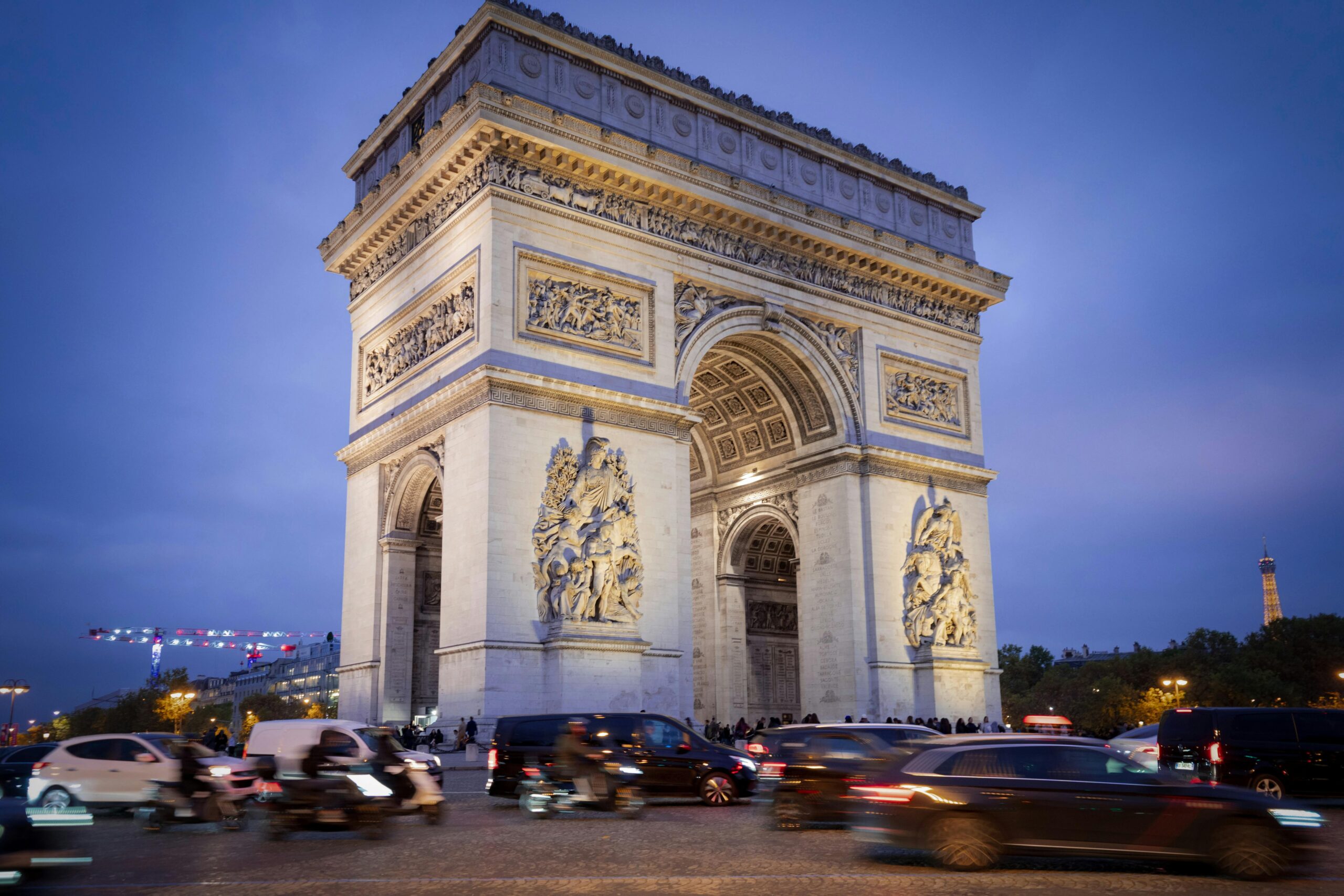
The problem with Paris is that everyone arrives already knowing it. The images are so thoroughly embedded — the tower, the river, the café chairs facing the street — that the city can feel like a confirmation of something rather than a discovery. What this familiarity obscures is that Paris is one of the most deliberately constructed cities in human history, a place that was physically remade in the 19th century to project a specific idea of what civilization should look like. Understanding that the project changes what you see when you walk through it.
How Paris Became Paris
The Medieval Foundation
Paris began on an island — the Île de la Cité, where the Seine narrows, and a natural crossing point made settlement logical. The Romans built a city there called Lutetia in the 1st century AD, and the foundations of that city are still visible beneath Notre-Dame, which sits on the site of a Roman temple. The island remained the heart of Paris for over a millennium: it is where the French monarchy consolidated power, where the first great Gothic cathedral in France was built, and where Sainte-Chapelle was constructed in the 1240s to house what Louis IX believed were the Crown of Thorns and a fragment of the True Cross. The stained glass of Sainte-Chapelle — fifteen windows of deep jeweled color filling the upper chapel — was designed not as art but as theology made visible.
Haussmann and the Reinvention of the City
The Paris that most visitors experience today is largely the creation of one man working on the orders of one emperor. Between 1853 and 1870, Baron Georges-Eugène Haussmann demolished roughly 60 percent of medieval Paris on the orders of Napoleon III and replaced it with the wide boulevards, uniform stone apartment buildings, and organized arrondissements that give the city its distinctive appearance. The project was simultaneously an act of urban modernization, a public health measure, and a tool of social control — the narrow medieval streets that had sheltered barricades during the 1848 revolution were replaced with wide avenues down which troops could move quickly. The Paris of Haussmann is the Paris of postcards, and knowing that it was engineered rather than evolved changes the way the city reads.
The City of Movements
Paris in the 20th century was where the intellectual and artistic movements that shaped modern culture came to define themselves. Impressionism, Cubism, Surrealism, Existentialism — these were not Parisian inventions in every case, but Paris was where they were argued over, published, exhibited, and given their names. The cafés of Saint-Germain-des-Prés were working offices for Sartre, de Beauvoir, Camus, and Hemingway not because Parisians were inherently more intellectual but because the city had developed a culture of public intellectual life — the café as a place to spend four hours on one coffee without embarrassment — that made sustained work in public possible. That culture persists in the city’s café life today in a genuinely unusual way.
The Character of the City
Paris is more polite than its reputation suggests and more demanding than visitors expect. The famous Parisian coolness toward tourists dissolves almost entirely with one word: Bonjour. The social contract of the city requires an acknowledgment before any transaction — in shops, cafés, pharmacies, anywhere — and the visitor who provides it is treated as a person rather than a source of revenue. The visitor who doesn’t is treated accordingly.
What Paris genuinely offers the solo traveler is a culture of sanctioned solitude in public. A table at a café in Paris is yours for as long as you want it — no one will rush you, suggest you move on, or look at you strangely for sitting alone for an hour with a book. The city was designed for exactly this: individual people occupying public space at their own pace. For a solo traveler, Paris at its best is not a city you sightsee through but one you simply inhabit for two days.
Places That Tell Paris’s Story
Notre-Dame de Paris. Now in the final stages of its post-fire restoration, Notre-Dame is more than a cathedral — it is the physical center of France itself. All distances in the country are measured from a brass star set into the pavement in front of it, and the building’s 850-year history contains within it most of the major chapters of French history.
Sainte-Chapelle. Five minutes from Notre-Dame and visited by a fraction of the people who queue for the cathedral. The upper chapel’s fifteen windows were the medieval equivalent of a cinema — a narrative of the Bible told in color and light to a population that could not read. Nothing in European architecture prepares you for the effect of the room.
The Musée d’Orsay. A former railway station converted into the world’s finest collection of Impressionist painting — a history that is itself a statement about what Paris values. The building’s transformation in 1986 was controversial; its success was so complete that it is now difficult to imagine the collection anywhere else.
Le Marais. The only major neighborhood in Paris that escaped Haussmann’s demolition intact — which is why its streets are still narrow, its buildings still pre-revolutionary, and its character still different from the uniform grandeur of the rest of central Paris. The Place des Vosges, built in 1612, is the oldest planned square in the city and one of the most beautiful.
Montmartre. The hill that stayed outside Paris city limits until 1860, which is why it developed as a separate village and why its character — steep cobbled streets, a working vineyard, artists’ studios — survived the Haussmann period. Sacré-Cœur was built between 1875 and 1914 as an act of Catholic penance after the Franco-Prussian War, which is perhaps the most Parisian origin story possible.
Why Paris Rewards the Solo Traveler
Paris is the city where being alone in public was elevated to a cultural form. The flâneur — the person who walks the city slowly and without destination, observing and absorbing — is a specifically Parisian concept, and it describes exactly what solo travel at its best actually is. The city’s layout, its café culture, its museums, and its parks are all oriented around the individual moving at their own pace. There is no city in Europe where the solo traveler is more naturally at home.
| 48 HOURS IN PARIS — THE GUIDE
The 48 Hours in Paris guide gives you the hour-by-hour sequence for both days, the specific insider moves that separate a good Paris trip from a great one, the no-tourist-trap restaurant list organized by meal type, and the complete transport guide, including the Le Havre cruise connection — everything you need to make 48 hours in Paris feel like it was designed for you. Get the guide on Etsy → $14.99 Browse all 12 European cities guides in the European Series at GoingSolo.Life/guides/ |
Ready to Go?
Paris is one of the original cities in Going Solo.Life European Series. When you’re ready to move from understanding the city to planning the days, browse all the 48-Hour Guides at GoingSolo.Life/guides/.
48-Hour City Guides
Ready to Go? Grab Your Guide.
Hour-by-hour itineraries built for independent travelers.
London, Paris, Vienna, Prague, Amsterdam and more — $7.99 each.
