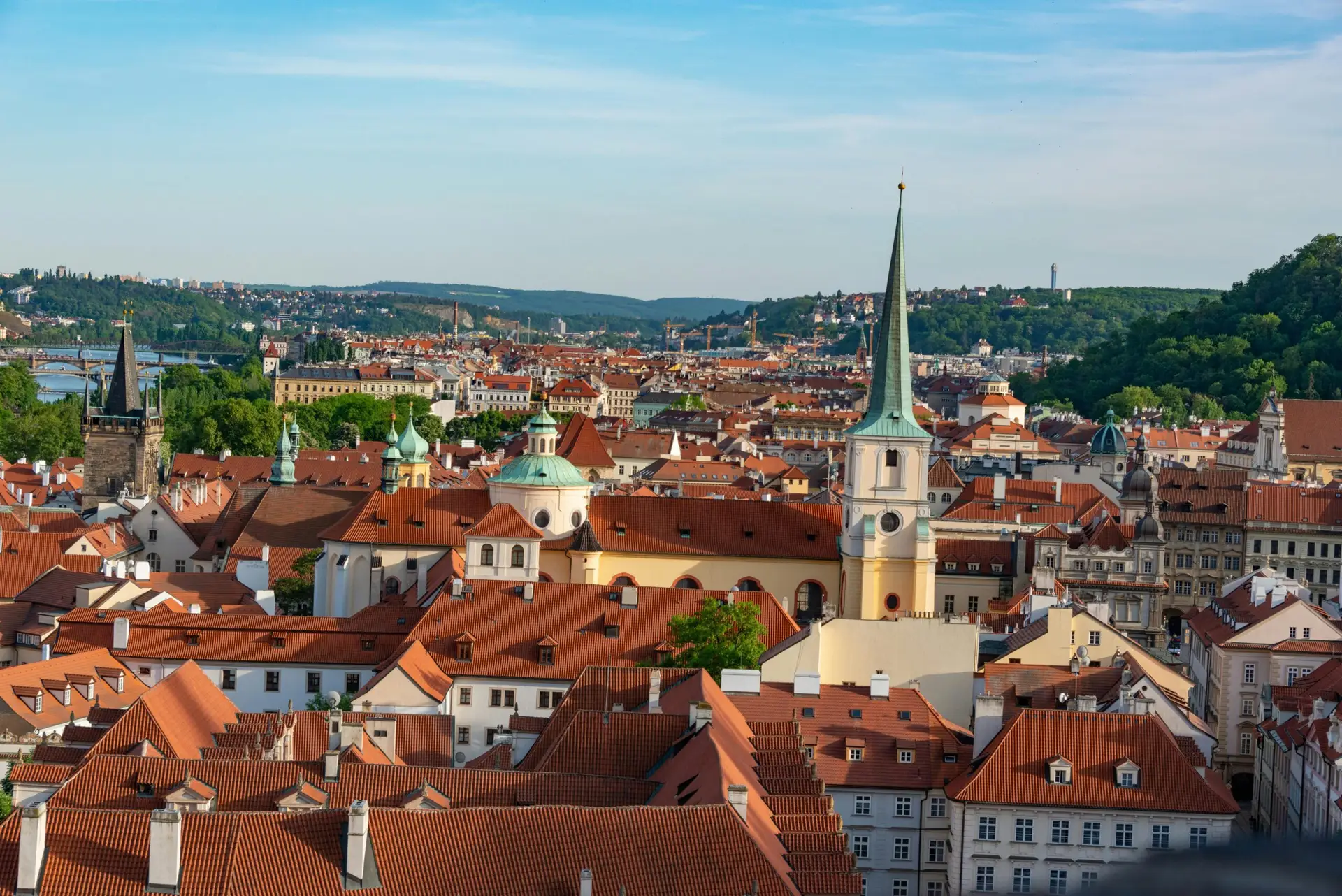
Prague makes sense from above before it makes sense at street level. The castle dominates the ridge, bridges pull the city across the Vltava, and church spires interrupt the skyline often enough that the entire place can feel less like a capital than a preserved argument between centuries. For a solo traveler, that matters. Prague rewards observation more than efficiency.
The History of Prague: How It Became What It Is
Prague’s story is tied to geography first. The Vltava River shaped the city long before it became the political and cultural center of the Czech lands. Settlements emerged around trade routes and fortified points along the river, eventually forming the districts that still structure Prague today: Old Town, Lesser Town, Hradčany, and New Town. What makes Prague unusual is not simply its age, but the extent to which those layers survived.
The Imperial City of Charles IV
Prague’s defining historical figure is Charles IV, Holy Roman Emperor and King of Bohemia, who transformed the city during the 14th century. In 1348, he founded New Town (Nové Město), dramatically expanding Prague beyond its medieval limits and turning it into one of Europe’s major political and intellectual centers. Charles University, founded the same year, remains the oldest university in Central Europe. The Charles Bridge, Prague Castle expansions, and the Gothic ambitions of St. Vitus Cathedral all belong to this period. Once you know this, Prague stops feeling accidental. The city was consciously shaped to project imperial seriousness.
A City That Escaped Total Reinvention
Unlike many European capitals, Prague avoided the scale of destruction that permanently altered cities such as Berlin or Warsaw during World War II. Large parts of its medieval and Baroque core survived, which explains why walking through Prague can feel unusually intact. Malá Strana still follows its historic street pattern beneath the castle. Old Town Square still functions as a civic center centuries after its formation. Even the Astronomical Clock, first installed in 1410, continues to mark time in the same square. Prague feels coherent because much of the city escaped the aggressive rebuilding that reshaped other capitals after war and industrialization.
The 20th Century and the Prague That Exists Today
Modern Prague was shaped by occupation, communism, resistance, and finally reinvention after 1989. The Nazi occupation devastated Prague’s Jewish community, a reality still visible in Josefov and the memorial spaces of the Jewish Museum. After World War II, Communist rule transformed daily life and architecture across the city for decades until the Velvet Revolution of 1989 peacefully ended the regime under the leadership of Václav Havel and others. Modern Prague still carries traces of all these eras simultaneously: imperial grandeur, wartime memory, Soviet-era functionality, and post-1989 revival. That layered tension is part of why the city feels intellectually heavier than its postcard reputation suggests.
What Makes Prague Distinct: Character, Culture & the Solo Experience
Prague moves differently from many European capitals. It is slower, quieter, and more atmospheric than cities built around spectacle or speed. The city’s rhythm is tied to walking, lingering, viewpoints, cafés, and gradual transitions between districts rather than dramatic single moments. Prague reveals itself incrementally.
The city also has an unusually strong relationship with public space. The riverfront embankments, beer halls, parks, bridges, and café culture all encourage lingering without pressure to perform productivity. Solo travelers benefit from that immediately. Sitting alone beside the Vltava, spending time in Letná Park, or crossing Charles Bridge at dusk never feels socially out of place here.
Prague’s visual coherence also changes how the city is experienced alone. The red rooftops, Gothic towers, Baroque domes, river crossings, and elevated viewpoints create a strong sense of orientation. The city is compact enough to feel manageable, but layered enough that every district carries its own atmosphere. Old Town feels medieval and ceremonial. Malá Strana feels intimate and Baroque. Karlín feels residential and contemporary. What makes the city especially rewarding is how easily everyday walks intersect with some of the most important historic sites in Prague, often without warning or ceremony. Prague rewards wandering because its districts still feel distinct from one another rather than flattened into a single tourist zone.
Places That Tell Prague’s Story
Prague Castle: Prague Castle has served as the seat of Czech rulers for more than a thousand years and remains the defining visual anchor of the city. It tells the story of Prague as a political and symbolic capital shaped by rulers who wanted the city to project permanence and authority.
Charles Bridge: Constructed under Charles IV during the 14th century, Charles Bridge physically and symbolically connects Prague’s historic halves. Walking across it reveals how the river shaped Prague’s geography, trade, and identity across centuries.
Old Town Square: Old Town Square has functioned as Prague’s civic and commercial center since the medieval period. The square tells the story of Prague as a city built around trade, public gathering, and layered architectural ambition rather than monumental scale alone.
Josefov: Prague’s Jewish Quarter contains some of the most important preserved Jewish heritage sites in Europe. The synagogues and Old Jewish Cemetery reveal both the depth of Jewish life in Prague and the devastating rupture caused by the Holocaust.
Vyšehrad: Vyšehrad sits above the Vltava south of the historic center and is tied to early Czech legends and statehood. The site tells a quieter Prague story: less imperial, less crowded, and more connected to national memory than tourist mythology.
Letná Park: Letná Park offers one of Prague’s clearest panoramic views, where the bridges line up across the Vltava below. It tells you how the city actually functions spatially: a capital organized by elevation, crossings, and river movement rather than straight lines.
Why Prague Rewards the Solo Traveler
Prague rewards solo travelers because the city naturally encourages independent pacing. It is not a place that demands constant scheduling or social momentum. Some of its best experiences are cumulative rather than spectacular: a slower walk through Malá Strana, a café that holds you longer than intended, the skyline changing color over the river, or a quiet stretch of embankment after dark.
The city also handles solitude well. Beer halls, cafés, parks, viewpoints, and tram rides all make being alone feel normal rather than conspicuous. Prague’s compact scale reduces stress, while its density of history keeps solo wandering intellectually rewarding. You are rarely far from a building, square, church, or street that changes your understanding of the city slightly.
Most importantly, Prague rewards attention. A group traveler often experiences the city as a checklist of landmarks. A solo traveler notices transitions: the way Old Town gradually loosens into New Town, the shift in silence crossing the river, the changing perspective of the castle from different elevations. Prague is a city best understood slowly.
48 HOURS IN PRAGUE — THE GUIDE
This article gives you the context. The guide turns that context into a real trip, with an hour-by-hour sequence, Prague Castle strategy, exact café and restaurant picks with prices, tram guidance, viewpoint timing, neighborhood flow, and insider moves designed specifically for solo travelers.
Ready to Go?
Prague is one of the rare cities that becomes more coherent the longer you walk through it. Give yourself time above the river, time below the castle, and enough unstructured hours for the city to reveal its rhythm gradually.
48-Hour City Guides
Ready to Go? Grab Your Guide.
Hour-by-hour itineraries built for independent travelers.
London, Paris, Vienna, Prague, Amsterdam and more — $7.99 each.
