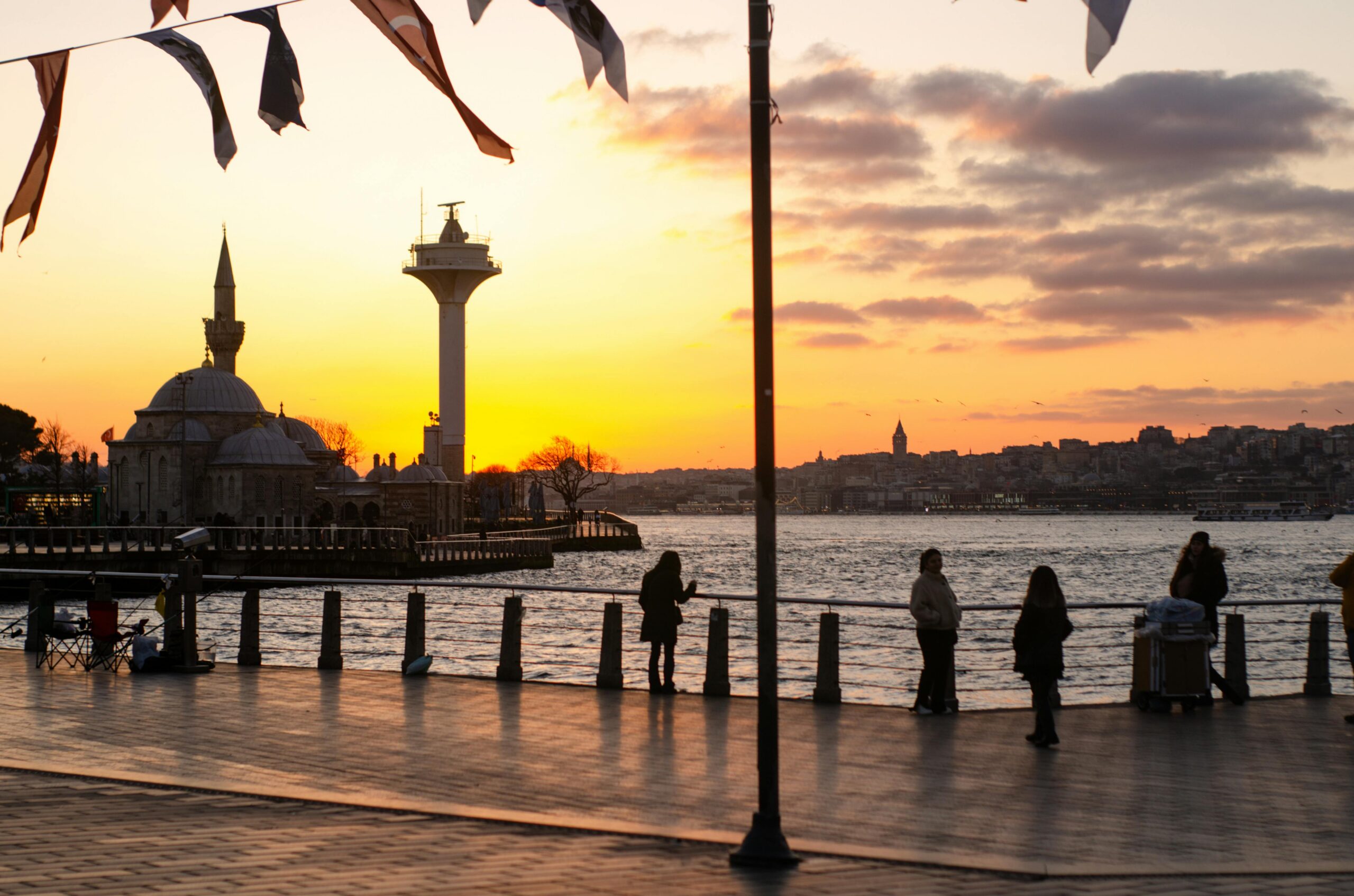
Istanbul is the only city in the world that sits on two continents, and that geographical fact is not just a trivia answer — it is the whole story. Everything that has made this city extraordinary, contested, and strange flows from the decision, made and remade across centuries, that this particular stretch of water was worth fighting over. For a solo traveler, Istanbul offers something rare: a city where history is not in museums but underfoot, and where the discipline to experience it alone, at your own pace, reveals a depth that a guided tour can only approximate.
The History of Istanbul: How It Became What It Is
Three civilizations, one city. What makes Istanbul legible to the curious traveler is not memorizing a list of sultans or emperors but understanding the three great chapters — Greek, Roman/Byzantine, and Ottoman — that each left the city a different kind of place. The streets you walk today are the product of all three decisions running simultaneously, sometimes in the same block.
Founded at the crossroads: Byzantium and Constantinople
Greeks from Megara founded Byzantium around 657 BCE at the precise point where the Bosphorus meets the Golden Horn. The harbor was so strategically perfect that the decision looked less like exploration than destiny. For nearly a thousand years the city served as the eastern capital of Rome. Constantine rechristened it Constantinople in 330 CE, and from that moment it became the most important city in the Christian world. The Hagia Sophia was not built as a tourist attraction. Finished in 537 CE, it was the largest building on earth — a deliberate demonstration that Constantinople was the center of civilization. The mosaics that survive today are physical evidence of that belief. Some are covered, some uncovered, some being argued over by governments. All of them speak for a city that believed it was the hinge of history.
The Ottoman transformation: 1453 and what followed
When Mehmed II captured Constantinople in 1453, he did something unusual for a conqueror. He chose to keep the city largely intact. He made it the capital of his empire. The Hagia Sophia became a mosque. Churches became medreses. A new imperial district grew around Topkapi Palace. But the old city’s bones remained. The Roman street grid survived. The Byzantine cisterns still held water beneath the streets. The walls that had held for a thousand years stayed standing. The result was a city built in geological layers. An Ottoman han stands on Byzantine foundations. A Byzantine column rises from a Roman forum. The Grand Bazaar began in 1461. It is still operating today. It sells the same categories of goods in roughly the same location it has occupied for more than five hundred years.
The Modern City: Republic, Reform, and the Twentieth Century
When Atatürk moved Turkey’s capital to Ankara in 1923, Istanbul lost its political primacy but not its cultural weight. The city became something new: a place that had to figure out what it was when it was no longer the center of an empire. The answer, over the twentieth century, was a city that became one of the great commercial and cultural metropolises of the Mediterranean world. The neighborhoods of Beyoğlu, Karaköy, and Pera — historically the cosmopolitan districts where foreign merchants and minority communities lived — became the creative heart of modern Istanbul. The tramline down İstiklal Avenue, the restored art nouveau facades, the galleries and music venues occupying former apartment buildings: these are the products of a city that learned, in the twentieth century, how to be Istanbul rather than Constantinople.
What Makes Istanbul Distinct: Character, Culture & the Solo Experience
Istanbul moves at a pace that is neither Eastern nor Western, which is exactly the point. The city has its own rhythm — tea-driven, conversation-forward, oriented toward the small pleasures of a glass of çay in a third-floor café above the Bosphorus. The Turkish concept of muhabbet, the pleasure of good conversation for its own sake, shapes social life in a way that is immediately welcoming to solo travelers. Locals are accustomed to sitting with strangers; the social infrastructure of tea houses, meyhanes, and waterfront fish restaurants is designed for lingering.
The city’s relationship to its own complexity is also distinctive. Istanbul’s residents carry multiple identities simultaneously — European and Asian, secular and religious, Ottoman and Republican — without apparent contradiction. For a solo traveler willing to move between neighborhoods rather than stay anchored to the tourist core, this means that the city keeps offering new versions of itself. The Fatih district and Cihangir are twenty minutes apart and feel like different centuries.
What surprises most visitors is how navigable Istanbul is once you stop treating it as a single place. The ferry system across the Bosphorus is cheap, frequent, and one of the great travel experiences available anywhere. Getting on a boat at Eminönü with no particular plan and arriving in Kadıköy is not a tourist activity — it is how the city works, and it is available to anyone willing to show up.
Places That Tell Istanbul’s Story
The Hagia Sophia needs no promotion. It rewards a particular kind of attention. Stand in the nave and look up at the dome. Then try to imagine the building as Justinian’s architects experienced it in 537 CE — before the minarets, before the carpets, before the centuries of controversy. The engineering achievement is staggering by any standard. Building something this ambitious in six years tells you something about what Constantinople believed it was.
The Basilica Cistern sits a few hundred meters from the Hagia Sophia. This is where the city’s Roman infrastructure becomes physical. It is not a decorative space. It is a working reservoir that held water for the city from the sixth century. The Medusa heads used as column bases are characteristically Roman in their indifference to orientation. The heads were placed upside down and sideways because they were structural pieces, not icons.
Topkapı Palace is not one building. It is a city within a city, spread across a headland with views of three bodies of water. Walk through it slowly. What emerges is not a sense of splendor but of administration. This is where an empire was actually run for four hundred years, by a bureaucracy as complicated as the building itself.
The Spice Bazaar is smaller and more navigable than the Grand Bazaar. It has been operating since 1664 and still functions as an actual market for the neighborhoods around it. The Grand Bazaar rewards a specific strategy. Pick one section. Ignore the tourist lanes. Find the shops where locals are buying rather than looking.
The neighborhoods of Karaköy and Galata sit just across the Golden Horn from the old city. This is where Istanbul’s contemporary life is most visible. Ottoman hans have been converted to artist studios. Nineteenth-century bank buildings now house galleries. Rooftop bars overlook the water. This is what the city became when the empire ended.
Why Istanbul Rewards the Solo Traveler
Istanbul is too large and too layered for a group to navigate well. A group makes decisions by committee; Istanbul rewards individual decisions — the unexpected turn into a neighborhood, the decision to follow a sound or a smell, the willingness to sit down in a tea house without knowing what happens next. The city is not hostile to groups, but it does not fully open itself to them.
Solo travel here also means that you experience the city’s warmth directly. Turks are genuinely curious about visitors who are trying to understand the city rather than simply photograph it. A solo traveler sitting with a map in a tea house in Fatih will be talked to. This is not harassment — it is the muhabbet impulse at work, the genuine pleasure in contact with someone making an effort.
The practical reality is also favorable: Istanbul is safe, well-connected by public transit, and has the infrastructure of a city that receives millions of visitors a year, but is large enough that stepping two blocks from the main tourist sites puts you somewhere that feels entirely your own.
| 48 HOURS IN ISTANBUL — THE GUIDE
Knowing the history of Istanbul is one thing. Knowing how to move through it — which neighborhoods connect, what to eat and where, how to use the ferry system, what the interactive map shows you that no article can — is what the 48-Hour Guide delivers. It’s a focused, hour-by-hour sequence built for the solo traveler who wants to use the city well, not just see it. Get the 48 Hours in Istanbul guide → $7.99 Browse all 48-Hour Guides at GoingSolo.Life/guides/ |
Ready to Go?
Istanbul is the kind of city that rewards everyone who takes it seriously — and takes solo travelers furthest of all. The scale is manageable, the welcome is real, and the history is still physically present in a way that few cities can match. Browse all the 48-Hour Guides at GoingSolo.Life/guides/ — more cities added regularly, and Istanbul is waiting.
48-Hour City Guides
Ready to Go? Grab Your Guide.
Hour-by-hour itineraries built for independent travelers.
London, Paris, Vienna, Prague, Amsterdam and more — $7.99 each.
