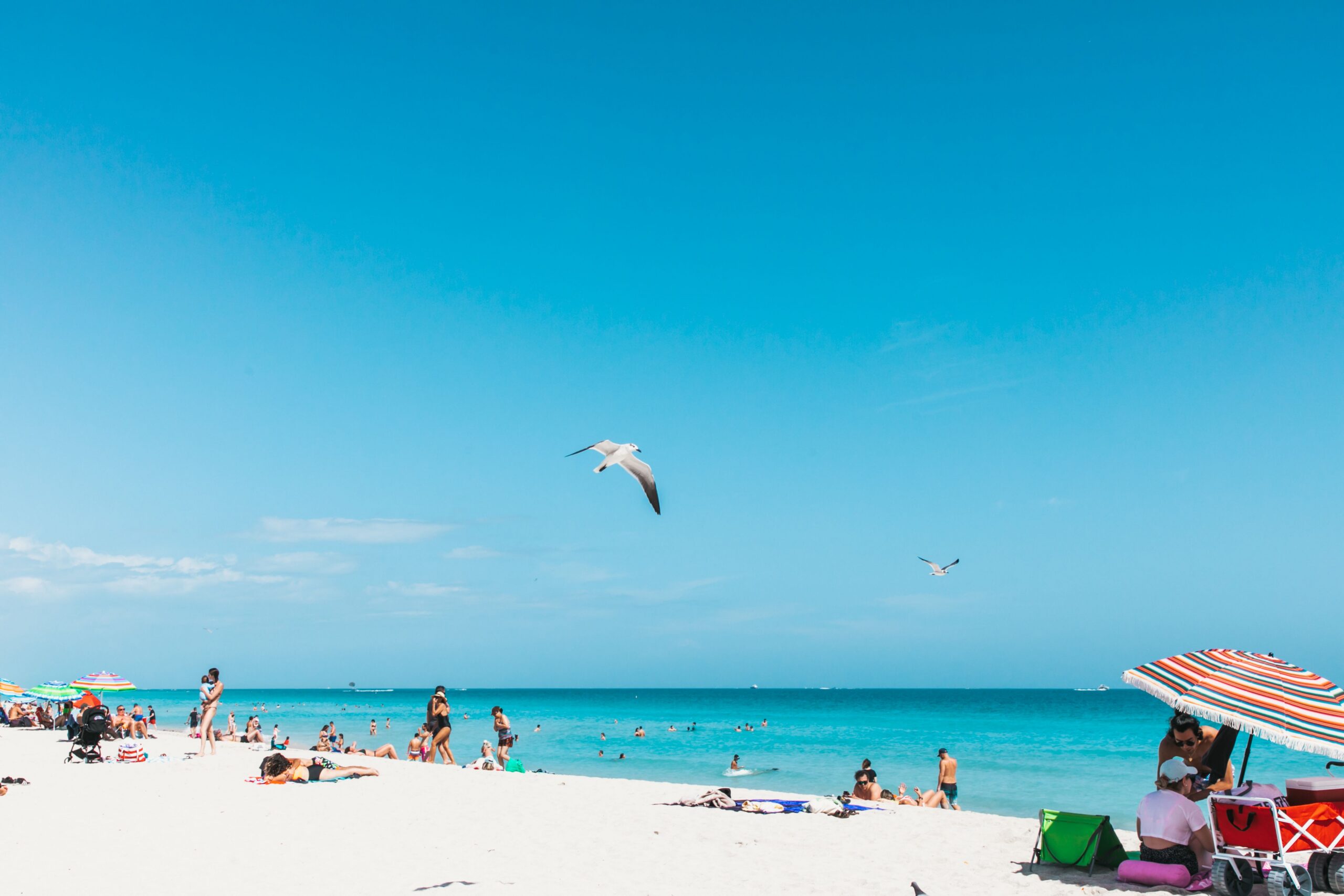
Miami has been a city for 130 years, which makes it younger than most American universities and almost absurdly young by the standards of the places most of its residents came from. This should be a disadvantage. A city with no history has no story to tell. But Miami found a way around this problem by having so many stories arrive from elsewhere — from Cuba and Haiti, from Colombia and Venezuela, from New York and Rio — that the city became something genuinely new: a Caribbean metropolis on the US mainland that belongs, culturally, to the Western Hemisphere rather than to any single nation. A solo traveler who understands this does not see a beach resort. They see one of the most interesting demographic experiments in the Americas.
The History of Miami: How It Became What It Is
Built by a Woman and a Frost
Miami does not exist without two things: a disastrous freeze and a determined woman. The freeze came in 1894–1895. It destroyed Florida’s citrus industry north of Palm Beach. Julia Tuttle owned a large tract of land on the north bank of the Miami River. She used that frost to persuade Henry Flagler to extend his Florida East Coast Railway south to Biscayne Bay. Flagler had already built Palm Beach into a resort for the American wealthy. He agreed.
The railroad arrived in April 1896. Miami was incorporated as a city four months later, with a population of around 300 people. This is not a metaphor for Miami’s character — it is the literal mechanism by which the city came to exist: a deal between a visionary woman and a railroad magnate, triggered by a weather event. Miami’s relationship to speculation, to reinvention, and to the belief that the right deal at the right moment can change everything is baked into the founding story.
The Boom, the Crash, and Art Deco
The 1920s Florida land boom transformed Miami Beach from a mangrove island into a real estate fantasy. Lots sold by the tens of thousands. Hotels and casinos rose overnight. The promise of perpetual sunshine attracted Northern capital faster than the city could absorb it. The bust came in 1926, accelerated by a devastating hurricane. Miami spent the Depression years rebuilding at a more human scale. The Art Deco Historic District that now defines South Beach is the direct product of that rebuilding. The 800-plus buildings constructed between 1923 and 1943 represent the largest concentration of Art Deco architecture in the world. Architects built them cheaply and quickly, using pastel colors and nautical details to make modesty look deliberate. What visitors now treat as the city’s defining aesthetic was born from financial necessity.
The Cuban City Within the City
The 1959 Cuban Revolution and the waves of exile that followed transformed Miami more fundamentally than any other event in its history. By the 1980s, Miami had a Cuban-born mayor. A Spanish-language newspaper outsold the English one. Little Havana functioned as a city within a city, with its own economy, cultural institutions, and political identity. The later waves layered additional identities onto a city that had already stopped being primarily Anglo-American — Mariel in 1980, the post-Soviet opening in the 1990s, Venezuelans and Colombians through the 2000s and 2010s, and a continuing flow of refugees from Cuba, Haiti, and Nicaragua. Miami today is majority Hispanic, majority foreign-born, and majority bilingual. This is not a feature of the city — it is the city.
What Makes Miami Distinct: Character, Culture & the Solo Experience
Miami is one of the few American cities where the standard narrative of American urban history does not quite apply. There is no industrial past, no working-class white ethnic neighborhood, no mid-century urban decline and suburban flight — or rather, all of those things happened, but they happened on top of an immigration story so continuous and so transformative that they read as secondary. The result is a city with a social culture that is more Caribbean than North American: outdoor, late-night, food-centered, and built around a hospitality that extends easily to strangers.
For the solo traveler, this produces specific advantages. The restaurant culture — Cuban sandwiches at a ventanita window, Haitian griot at a neighborhood spot in Little Haiti, Venezuelan arepas in Doral — is designed for eating quickly and well at any hour. The Art Deco district on South Beach is best absorbed on foot, alone, before the crowds arrive. The Wynwood Walls and the Design District reward independent wandering more than any group tour. Miami’s infamous traffic aside, the neighborhoods are distinct enough that each one feels like a separate city worth a full morning.
Places That Tell Miami’s Story
Little Havana, Calle Ocho. The eight-block stretch of Southwest 8th Street is the commercial and cultural spine of the Cuban exile community. Cigar rollers work in open windows. Domino players fill Maximo Gomez Park. The Versailles Restaurant has been feeding Cuban Miami since 1971. It is not a theme park. It is a functioning neighborhood that happens to be one of the most culturally specific blocks in America.
The Art Deco Historic District. The 800-building concentration on South Beach reads differently once you know it was built by architects working cheap in the Depression years. The best way to understand it is the free self-guided walking tour along Ocean Drive and Collins Avenue. Go in the early morning, before the tourists arrive, when the geometry and color are most visible.
Vizcaya Museum and Gardens. James Deering’s 1916 Italian Renaissance villa sits on the Biscayne Bay waterfront. A farm equipment millionaire built it because he wanted a European palace in the tropics. He got something stranger and more interesting than either. The gardens were designed to look centuries old from the moment they were planted. They are one of the most beautiful spaces in Florida.
Wynwood Walls. In 2009, a derelict warehouse district became the largest permanent outdoor street art collection in the world. It is now a tourist destination. But the neighborhood that grew around it — galleries, studios, restaurants, craft breweries — represents Miami’s most recent reinvention cycle. It is still ongoing.
The Freedom Tower. The 1925 Mediterranean Revival tower on Biscayne Boulevard served as the processing center for Cuban refugees from 1962 to 1974. It is the Ellis Island of the Cuban exile. Now a museum and cultural center, it is the most direct physical representation of the immigration history that made modern Miami.
Why Miami Rewards the Solo Traveler
Miami is a genuinely easy city to navigate alone — the neighborhoods are self-contained enough that a morning in Little Havana, an afternoon at Vizcaya, and an evening in Wynwood each constitute a complete independent experience. The food culture rewards solo eating: the ventanita counter, the Cuban cafeteria, the Haitian restaurant with four tables — these are not solo-unfriendly environments, they are the environments the city runs on. The beach is, obviously, the most democratic public space in the city: a solo traveler with a towel has the same access as anyone else. And Miami’s reputation as a party city, while earned, is a surface phenomenon. The city beneath it — multilingual, multigenerational, historically layered — is the one worth the trip.
48 HOURS IN MIAMI — THE GUIDE
The guide gives you the hour-by-hour sequence through Little Havana, the Art Deco district, Wynwood, and the Biscayne Bay waterfront — with the specific counters, galleries, and beach timing that makes Miami work for a solo traveler on a 48-hour schedule. The transport logistics and neighborhood-by-neighborhood safety notes are all there too.
Get the 48 Hours in Miami guide → $7.99
Browse all 48-Hour Guides at GoingSolo.Life/guides/
Ready to Go?
Miami is one of the most misunderstood cities in the United States — easier to dismiss than to understand, and far more interesting than its reputation suggests. The solo traveler who arrives with some history in their pocket will see a different city entirely. Browse all the 48-Hour Guides at GoingSolo.Life/guides/ — each one built for the traveler who wants to go deeper.
48-Hour City Guides
Ready to Go? Grab Your Guide.
Hour-by-hour itineraries built for independent travelers.
London, Paris, Vienna, Prague, Amsterdam and more — $7.99 each.
