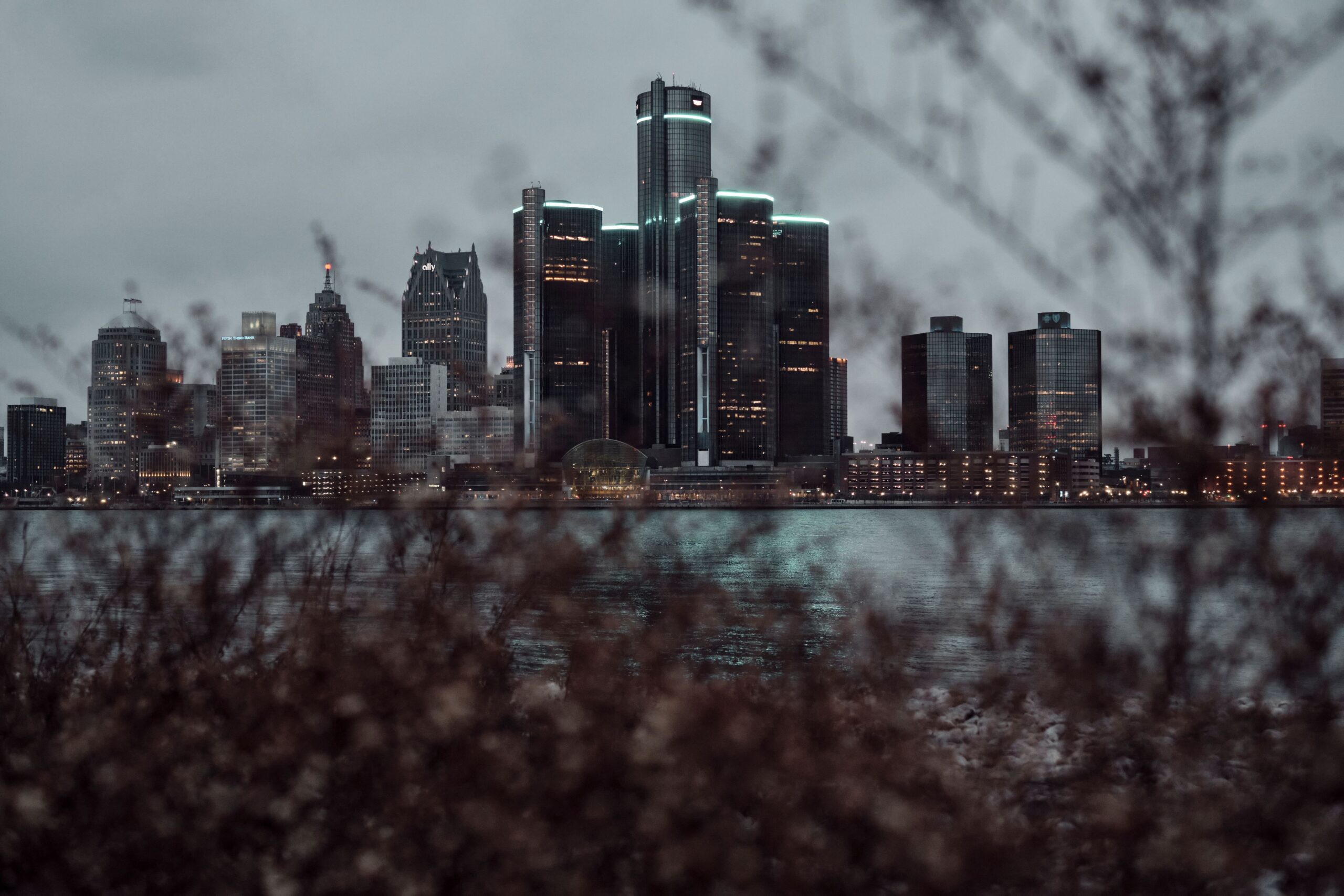
Detroit is the city that built the American middle class, paid for it in full, and is still working out what comes next. No other American city has risen and fallen so completely on a single industry, and no other American city has produced, as a byproduct of that rise and fall, such a specific and irreplaceable contribution to global culture: the assembly line, Motown, techno, the muscle car, the urban farm. A solo traveler who arrives expecting ruin tourism and stays long enough to understand the place will find something considerably more interesting — a city in the middle of a genuinely original reinvention, still in process, still contested, and entirely honest about both.
The History of Detroit: How It Became What It Is
The Arsenal of the Automobile
Detroit was a mid-sized Midwestern city of no particular distinction until Henry Ford opened the Highland Park plant in 1910 and introduced the moving assembly line in 1913. Within a decade, Detroit was producing half the automobiles in the world and the industry had transformed a regional manufacturing center into the most economically dynamic city in America. The wages Ford paid — $5 a day in 1914, roughly double the prevailing manufacturing wage — attracted workers from Appalachia, from Eastern Europe, from the American South, from Mexico, creating the demographic mix that would define the city for the rest of the century. By 1950, Detroit had 1.8 million people, the highest per-capita income of any American city, and a middle class built on factory wages that had no precedent in industrial history.
The Great Migration and the Music It Made
Between 1915 and 1970, roughly 400,000 Black Americans moved from the Deep South to Detroit, drawn by the auto industry wages and the relative (relative) freedom of the urban North. They settled on the east side, built churches and businesses and social institutions, and produced, in the 1950s and 1960s, one of the most concentrated periods of musical creativity in American history. Berry Gordy founded Motown Records in a two-story house on West Grand Boulevard in 1959 with $800 borrowed from his family. Within five years he had created the sound that the rest of the world identified as American popular music — the Supremes, the Temptations, Marvin Gaye, Stevie Wonder — recorded in an eight-track studio the size of a living room. The house is still there. You can tour it. The scale of what happened inside it makes the building impossible to process.
The Long Decline and What Came After
The 1967 uprising, the deindustrialization of the 1970s and 1980s, and the mass suburbanization that followed — driven in part by discriminatory mortgage policies and deliberate highway routing through Black neighborhoods — reduced Detroit’s population from 1.8 million in 1950 to under 700,000 today. The 2013 municipal bankruptcy, the largest in American history, was the formal acknowledgment of a fiscal crisis that had been building for forty years. But the bankruptcy also cleared the way for a rebuilding process that is still happening — in the Midtown and New Center neighborhoods, in the Eastern Market food district, in the urban agriculture projects and artist studios that moved into the vacancy. Detroit today is a smaller city than it was, but it is not an abandoned one. It is a city figuring out what it is next.
What Makes Detroit Distinct: Character, Culture & the Solo Experience
Detroit has a directness that other American cities lack. The history is not hidden or prettified — the evidence of the boom and the bust are both visible, often on the same block, and Detroiters do not pretend otherwise. This produces a social culture that is unpretentious and genuinely welcoming to curiosity: the person at the next stool at a Corktown bar will tell you what they actually think about the city’s recovery, will point you toward the jazz club that opened last year, will have an opinion about the new developments downtown and whether they are serving the existing community.
The food scene that has emerged in the last decade is Detroit’s most visible reinvention. The Eastern Market — the largest historic public market district in the United States, operating since 1891 — anchors a food ecosystem that includes Saturday farmers markets, some of the best chefs in the Midwest, and a Vietnamese and Middle Eastern restaurant culture built by the communities that settled in southwest Detroit and Dearborn. The Detroit-style square pizza — thick-crusted, cheese-to-edge, sauce on top — is not a novelty. It is the product of a city that ate communally, on steel trays, in factories and church halls.
Places That Tell Detroit’s Story
The Motown Museum (Hitsville U.S.A.). The two-story house on West Grand Boulevard where Berry Gordy recorded the sound of the 1960s is one of the most emotionally powerful small museums in America. Studio A — the actual recording room — is preserved as it was. The smallness of it is the revelation: the entire American popular music era was built in a room the size of a suburban garage.
The Detroit Institute of Arts. The DIA holds one of the ten greatest art collections in the United States — including Diego Rivera’s Detroit Industry Murals, a four-wall fresco cycle commissioned in 1932 depicting Ford’s River Rouge plant as a temple to human labor. It is the greatest artwork about industrial America ever made, and it is in Detroit because that is the only place it could have been made.
Eastern Market. The six-shed public market operating since 1891 is the economic and social center of Detroit’s food culture. On Saturday mornings it is the most democratic space in the city: farmers, vendors, chefs, and ordinary Detroiters from every neighborhood sharing the same ground.
Belle Isle. The 982-acre island park in the Detroit River — designed by Frederick Law Olmsted, the designer of Central Park — contains an aquarium, a conservatory, a maritime museum, and miles of shoreline with views across to Windsor, Ontario. On a summer morning it is the Detroit that the city’s own residents most love and that visitors rarely find.
The Guardian Building. The 1929 Art Deco skyscraper in the financial district — nicknamed the Cathedral of Finance — is one of the finest interiors in American architecture: Pewabic tile, Rookwood pottery, Tiffany Studios details, a banking hall that makes clear what the auto industry boom felt like from the inside. Free to enter during business hours.
Why Detroit Rewards the Solo Traveler
Detroit rewards the solo traveler specifically because the city’s story requires attention and context to understand — and both are easier to bring when you are not managing a group. The Motown Museum is an experience best had quietly. The Rivera murals at the DIA take a full hour to read properly. The conversations that happen at Eastern Market on Saturday morning, or at a Corktown bar on a weeknight, are conversations that solo travelers fall into naturally. Detroit is also, practically, an easy city to move through alone: the Midtown and New Center neighborhoods are walkable, the downtown core is compact, and the people you meet will give you better directions than any app.
48 HOURS IN DETROIT — THE GUIDE
The guide gives you the hour-by-hour sequence through downtown, Midtown, Corktown, Eastern Market, and Belle Isle — with the specific restaurants, the Motown Museum logistics, the DIA timing, and the practical notes on getting around a city that was designed for cars but is increasingly navigable on foot. Detroit requires a sequence to make sense. Here is the sequence.
Get the 48 Hours in Detroit guide → $7.99
Browse all 48-Hour Guides at GoingSolo.Life/guides/
Ready to Go?
Detroit is one of the most misread cities in America — easier to write off than to understand, and considerably more interesting than the narrative of decline allows. The solo traveler who arrives with the history in hand will find a city that is honest, generous, and entirely unlike anywhere else. Browse all the 48-Hour Guides at GoingSolo.Life/guides/ — each one built for travelers who want the full picture.
48-Hour City Guides
Ready to Go? Grab Your Guide.
Hour-by-hour itineraries built for independent travelers.
London, Paris, Vienna, Prague, Amsterdam and more — $7.99 each.
