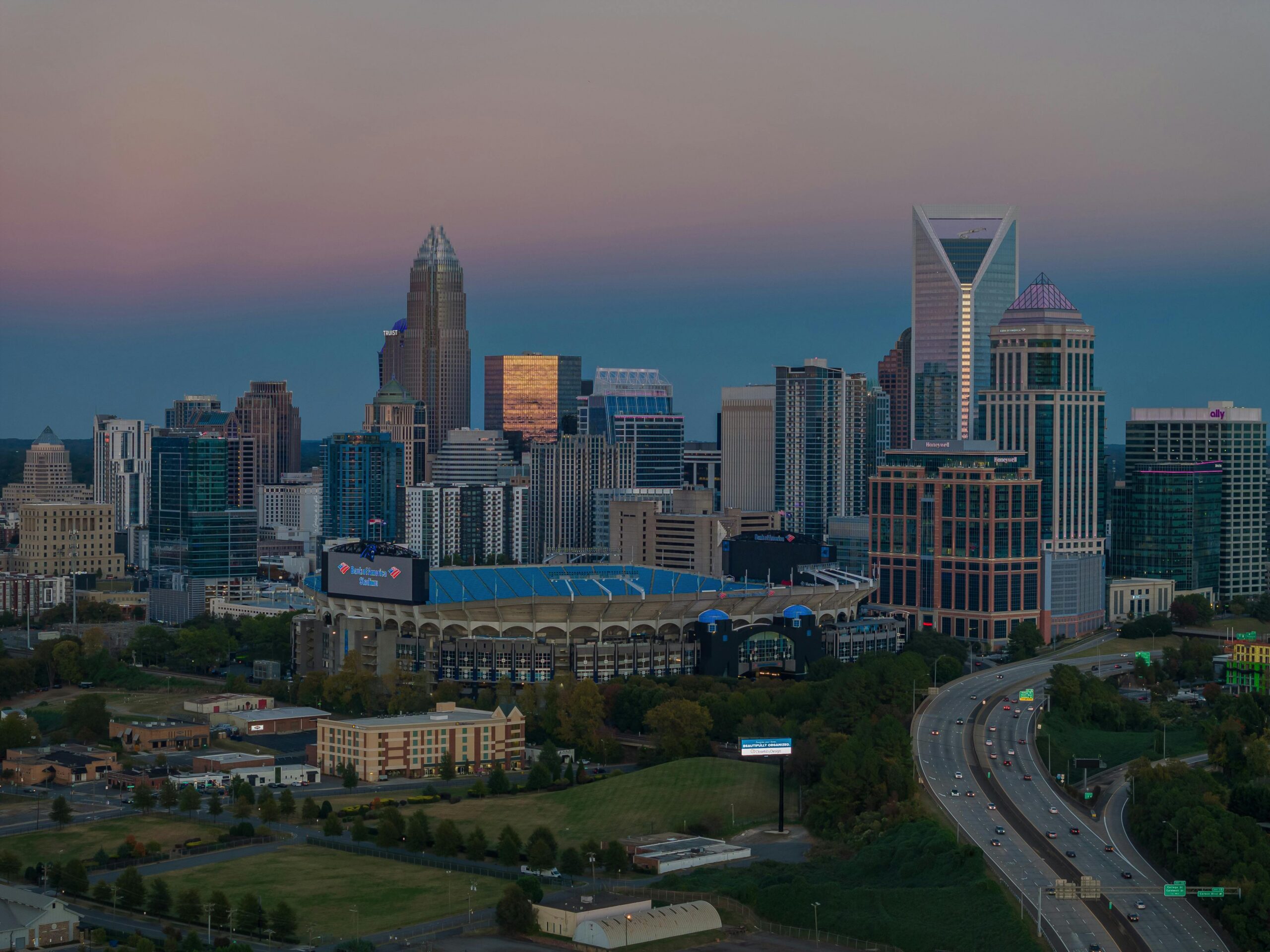
Charlotte is a city that has remade itself completely at least three times — from colonial crossroads to gold rush boomtown to textile mill capital to the financial center that now defines it — and the energy of that constant reinvention is present in everything here. It is not a city that trades on nostalgia. It is a city that is actively in the process of becoming something, and a solo traveler who shows up curious rather than expecting the Charlotte of ten years ago will find something worth discovering.
The History of Charlotte: How It Became What It Is
Charlotte’s story is a Southern story with an unusual economic twist: this city became important not through agriculture or manufacturing alone but through money — first literally, in the form of gold, and then institutionally, in the form of banking. Understanding that thread explains why Charlotte looks the way it does and why it has the ambitions it does.
The First Gold Rush: America’s Original Mining Boom
In 1799, a twelve-year-old named Conrad Reed found a seventeen-pound gold nugget in a creek on his family’s Cabarrus County farm — the first documented gold discovery in the United States, fifty years before California. The Reed Gold Mine became the first commercial gold mine in the country, and the Piedmont region around Charlotte was the center of American gold production until 1848. The United States Mint opened a branch in Charlotte in 1837 specifically to process local gold; the building still stands on Mint Street, now housing the Mint Museum. This is not a minor historical footnote — Charlotte was producing real economic value at a time when the region was otherwise a colonial backwater, and the habit of treating the Piedmont as an economic asset rather than a scenic backdrop dates from this period.
The Textile Era: Mill Towns and the New South
After the Civil War, Charlotte became the center of a textile industry that would define the Piedmont South for the next century. The mill towns built around Charlotte — Kannapolis, Gastonia, Concord — were company towns in the full sense: the mills owned the houses, the churches, and the social infrastructure of the workers who ran them. The legacy of this period is visible today in the mill buildings being converted to apartments and offices, and in the working-class character of the neighborhoods immediately outside Charlotte’s urban core. The textile industry peaked in the 1960s and declined sharply through the 1980s and 1990s as production moved overseas. What it left behind was a city that had learned to be productive and that needed a new identity.
The Banking Capital: How Charlotte Became a Financial Center
Charlotte’s transformation into one of the largest banking centers in the United States is the result of a specific piece of 1970s legislation and two aggressive bankers. North Carolina’s 1972 banking laws allowed statewide branching before most other states, giving Charlotte-based banks the ability to expand rapidly. Hugh McColl at NCNB — later BankAmerica, later Bank of America — and Ed Crutchfield at First Union used that advantage to build national institutions through decades of acquisitions. By the time Bank of America’s headquarters opened on South Tryon Street in 1992, Charlotte had become the second-largest banking center in the country after New York. The glass towers of Uptown Charlotte are not incidental to the city’s history — they are the current chapter of a story that started with a gold nugget in a creek.
What Makes Charlotte Distinct: Character, Culture & the Solo Experience
Charlotte is a city of neighborhoods. The shiny Uptown skyline doesn’t immediately suggest that. The historic African American community of Cherry, the Victorian bungalows of Plaza Midwood, the South American restaurants of the Hidden Valley area, the independent breweries of NoDa (North Davidson) — these are not tourist districts. They are functioning communities with distinct characters that have survived or emerged alongside the city’s corporate transformation.
The food culture reflects this diversity and rewards exploration. Charlotte has one of the fastest-growing Latino populations of any Southern city. The restaurants around South Boulevard and Central Avenue reflect that. Venezuelan, Colombian, Peruvian, and Mexican cooking thrives here — authentic and largely unknown to the tourist circuit. NoDa was historically an arts district built around old mill buildings. It has since developed a restaurant and bar culture alongside its galleries and live music venues. That makes it one of the more interesting evening destinations in the South.
What surprises most visitors is how culturally ambitious Charlotte has become. The Bechtler Museum of Modern Art, the Harvey B. Gantt Center for African American Arts and Culture, the Knight Theater — these are not the cultural institutions of a city coasting on financial success. They are the products of a deliberate decision. Over the past twenty years, Charlotte chose to build a city worth inhabiting rather than just worth working in. That decision is still in progress. That makes Charlotte interesting to watch.
Places That Tell Charlotte’s Story
The Mint Museum Uptown houses one of the finest collections of American craft and design in the Southeast. Don’t confuse it with the original Mint Museum on Randolph Road. The building on Levine Center for the Arts is worth visiting for the architecture alone. It also provides context: this is the cultural investment Charlotte made in the 2000s as a statement about what kind of city it intended to be.
The Harvey B. Gantt Center for African American Arts and Culture sits on the same block as the Bechtler and the Mint. It is named for the first African American mayor of Charlotte. Gantt was also an architect who designed several significant buildings in the city before entering politics. His story — designer, mayor, near-senator — is a useful lens for understanding Charlotte’s racial history and its ongoing navigation of that complexity.
Fourth Ward is the historic residential neighborhood immediately north of Uptown. It contains the Victorian-era houses that predate Charlotte’s banking transformation. Walking these blocks is the quickest way to understand what Charlotte looked like before the glass towers. The shaded streets, careful restorations, and occasional plaques marking significant addresses tell that story plainly.
Go Further
The Levine Museum of the New South sits adjacent to the convention center in Uptown. It tells the history of the Piedmont South from Reconstruction to the present. It is unusually direct about the region’s racial history. The permanent exhibition “Cotton Fields to Skyscrapers” is the best single-source introduction to how Charlotte became what it is.
NoDa — the North Davidson arts district built in repurposed cotton mill buildings along North Davidson Street — best represents Charlotte’s current moment. Galleries, independent coffee shops, craft breweries, and live music venues now occupy former mill structures. They are the products of an artist community that moved in when the buildings were cheap and stayed after they became expensive. It’s still worth the visit.
Why Charlotte Rewards the Solo Traveler
Charlotte is genuinely easy to be alone in. Part of the reason is that it is a city of young transplants — professionals who moved here for work and are still learning the city themselves. The social culture is not insular in the way of older, more established cities. People are accustomed to meeting strangers. Southern convention also disposes them toward friendliness.
The city’s compactness works in the solo traveler’s favor. Uptown Charlotte, South End, and NoDa are all connected by the LYNX Blue Line light rail. That makes moving between the financial district, the brewery corridor along South Boulevard, and the arts district along North Davidson genuinely convenient. A solo traveler can spend a serious cultural afternoon at the Bechtler, walk to dinner in Fourth Ward, and take the light rail to NoDa for the evening. No car needed.
Charlotte also rewards the traveler interested in cities as economic projects rather than just aesthetic ones. This is a city visibly working on itself — the cranes in Uptown are not decorative. The questions Charlotte is grappling with are the questions American cities broadly are asking: how to build a place that is both economically dynamic and livable for everyone who lives in it. Arriving with those questions in mind makes even the corporate skyline interesting.
| 48 HOURS IN CHARLOTTE — THE GUIDE
Charlotte’s neighborhoods don’t announce themselves — you need to know where to look, what to eat, and how to build days that connect Uptown’s cultural institutions with the energy of NoDa and South End. The 48-Hour Guide does that: a focused sequence, specific recommendations, and the interactive map that shows you how it all fits together geographically. Get the 48 Hours in Charlotte guide → $7.99 Browse all 48-Hour Guides at GoingSolo.Life/guides/ |
Ready to Go?
Charlotte rewards travelers who show up curious and without a fixed idea of what a Southern city should be. It is a city in motion, with serious cultural ambitions and a food scene that keeps expanding. Browse all the 48-Hour Guides — Charlotte is in the U.S. Series, and the guide gives you the two days that make it click.
48-Hour City Guides
Ready to Go? Grab Your Guide.
Hour-by-hour itineraries built for independent travelers.
London, Paris, Vienna, Prague, Amsterdam and more — $7.99 each.
